Friday, March 31, 2006

Mama, the water talks to me !

The Importance of Visualization.
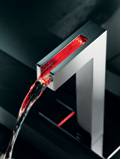
Soon we will have colored water leaving our taps. It may sound weird or even farfetched. But only at first sight. In reality this is an earthquake in our bathrooms.
We, humans, already deserved to have colored water for more than 2000 years. Only now we have the technology to actually let the water talk to us and indicate whether it is cold (blue), warm (rose) or hot (red). Imagine the importance for our children!

The color of the water is an answer to a question everyone poses himself in the nanosecond before he reaches out to wash his hands. It is a question we ask ourselves without even realizing it anymore. But our primitive system does raise the question. It wants to protect us from burning our hands. Hot or cold? That is what we need more, products that really talk to us.

(Pictures, the design taps from the German company Hansa. Today for the Happy Few, tomorrow for everybody)

Thursday, March 30, 2006

When it can't be done. Do it. If you don't do it, it doesn't exist.

"A NEW idea can be either unfamiliar, or silly, or both.
It can't be judged by description. It needs to be done (made) to exist.
It is unlikely that anyone will sanction the cost of something they don't understand, therefore you have no choice but to do it yourself.
At whatever cost.
You may have to BEG, STEAL and BORROW to get it done. But that's for you to work out how you do it.
It's exciting.
It's difficult and it's fun.
If it was easy anyone could do it."

(Paul Arden, Executive Creative Director Saatchi and Saatchi for 15 years. In his book: "It's not how good you are, it's how good you want to be")

Friday, March 17, 2006

Speeddating for Managers

How to organize a meeting between 600 people ?

-Paris this week-
When I started to attend the 'Journees de la Presse' in France a few years ago I was confronted with a simple but efficient system to bring 600 people together in 1 day.

- The organizer (NMPP) rents a conference room in a 5 star hotel.
- The organizer divides his contacts up in two groups: 'receivers' and 'guests'.
- The conference room will be filled with tables for 4 people.
- The tables are nicely positioned in 'rows' and 'columns'.
- All 'rows' receive (a bit as in chess) a number. All 'columns' receive a letter.
- Numbers and letters are put on big signs along the conference room.
- 'Receivers' are invited to take place at the tables for a day.
- 'Guests' are invited to walk around and 'visit' the receivers following a tight schedule of 30 minute meetings.

The only thing 'guests' and 'receivers' have to do is organize their meetings before the actual meeting day. This sometimes involves intricate puzzling by the secretaries of all managers present.

An interesting side effect of this kind of very structured event are the unofficial meetings that tend to grow outside the official conference room. This kind of event can also be a moneymaker for the organizer. It is not unusual for the organizer to actually 'rent' his tables to the 'receivers' and asks income from the 'guests'.

Left: This sign gives an overview of all the 'recievers' and their code to indicate their position in the conference room. The sign is posted at the entrance of the conference room + it is printed in the conference catalogue.

Wednesday, March 01, 2006

5 cynical tips to become a successful entrepreneur


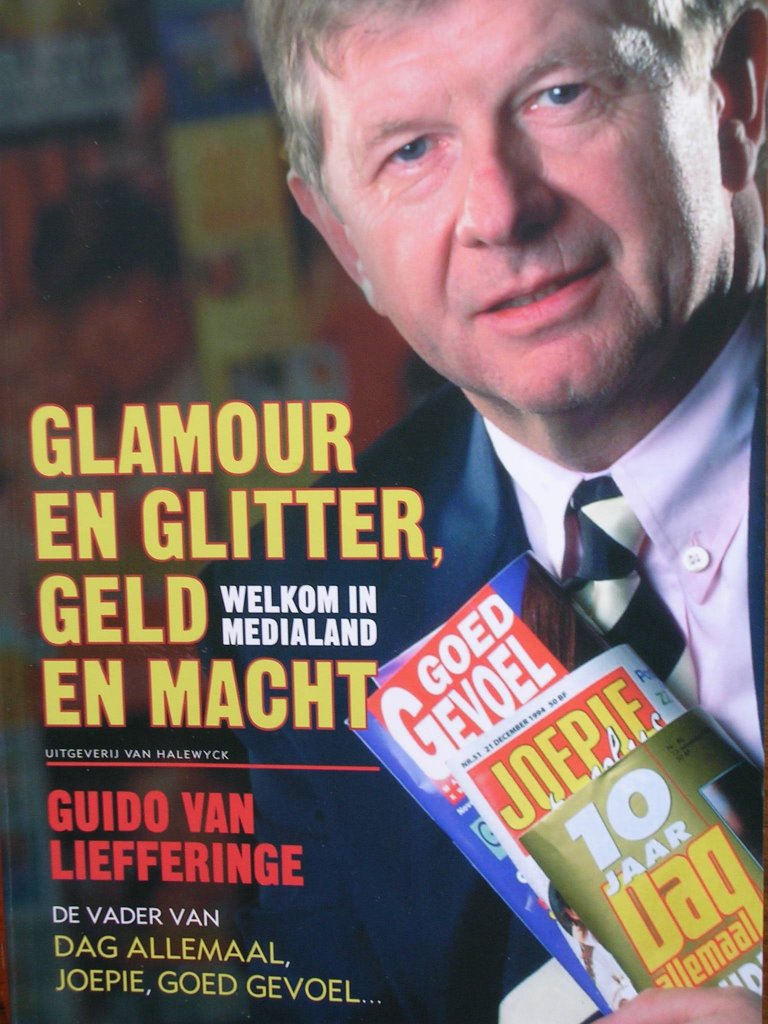
The biography of a fairly unknown man, Mr Van Liefferinge (see picture left), came out recently. Although unknown the man invented all best selling magazines in Belgium during the last 20 years. He also became extremely rich in the process doing so. Guido Van Liefferinge has 'print' running through his veins. Moreover he was a media-mastermind looking after the democratic values of a free, but popular press.

Unfortunately to be able to launch all these successful magazines he had to cooperate with one of Belgians largest publishing houses, De Persgroep. His longtime relationship with this media powerhouse ended beginning 2000 in a disgraceful fight. De Persgroep allegedly removed him wrongful from his position cutting the ties between him, the inventor (or father) and all his magazines (his children, as he writes). He is now fighting a fierce legal battle with his former partner.

The book is more then an account of how he invented the magazines, it is a complaint against the management of De Persgroep. It is a bitter book by a bitter man, although he claims not to be.
He gives the following (cynical) advice to become a successful entrepreneur today:
1. Your primary goal is 'networking'. Alumni of managementschools, high level consultants, members of the establishment, all people who meet each other for the wrong reasons, are goldmines for your career.
2. Lobby. You can not stop sucking up government and her representatives to obtain government funds, subsidies, licenses etc, 'goodies' a normal entrepreneur does not need to build his business in the normal way in a normal deregularised market.
3. Divide et Impera. After having had confidential conversations, go with the info to third parties or change the content and spread around.
4. Keep secret agenda's. Just lie about the real goals of your actions. Remember that these days 'perception is reality'. Act as if your are building a transparent house, but build it on perceptions.
5. Start with 'perception -management'. Tell the world you are the best, do it over and over again, till everybody believes it. Use and misuse your contacts in the media. Lie about the competition or lie about people in your company you don't like anymore.
As said, the above 5 rules are not meant to be followed by 'good' people. They merely explain why 'bad' people become successful entrepreneurs.

Before I knew who he was he called me one day in 1995. He wanted to speak to me about a magazine I was publishing. Since I didn't know him, and since he had called me, I kind of said that if he wanted to speak to me he should come to my office some 70 km from where he had his office. It was as if the caretaker ordered the king to come down to the basement, I realized myself years later. He abruptly said "I think you should come to me, it will be worthwhile". "But I had a car accident," I replied, "I am wearing a collar and I don't have a car anymore." He replied "I still think you should come to me, take a taxi (70 x 2 = 140km!!!!), it will be the best investment you ever made". I went to see him, evidently. Nothing came from it :-) apart from the fact that I learned more about magazine publishing in the 1 hour I was with him, than all the years at school and university.
Monday, February 27, 2006

About eating alone on a businesstrip

Ireland - Birr. Nightly visit of a printplant. Wanted to eat in a typical Irisch pub, but they don't serve food after 8PM in a small village like Birr. Ended up in the uptight restaurant of the only hotel in town. Don't like eating alone in restaurants. At least in a pub or brasserie you see some movement.

Tell me how you spend your meals as a manager alone on the road.

Sunday, February 26, 2006

The Hawthorne Effect - 3 things to learn

The truth about being good to people

Between 1924 and 1927 a scientist, Elton Mayo, conducted experiments at the Western Electric Hawthorne Works in Chicago on the effect of light on productivity. The experiments showed no clear connection between productivity and the amount of light at the workplace. However Mayo wondered what kind of changes at the workplace would indeed influence the production.
In further studies at the Hawthorne factory between 1927 and 1932 he found out an amazing thing! Basically he found out that workers acted according to sentiments and emotion! He said that if management would treat the employees with respect and give them the attention at the workplace they needed, then the workers would be willing to work harder for the employer.

The Hawthorne Effect = the more you show interest in people, the more you show you are concerned, the better the job performance of the employees.

An interesting side-effect of this theory is the duality with the concept of 'training'. Training educates employees, but the mere act of gaining more knowledge doesn't necessarily mean that the employee will be motivated to perform better. An employee will be motivated to perform better because he feels supported by his management. Because they take care of his training, by paying for it, by organizing it. The motivation is independent of the knowledge an employee may have gained from training. That also is the Hawthorne Effect.
It is said that at least 50 % of a successful training should be attributed to the Hawthorne Effect.


What can we learn here?
1. The need for recognition, security and sense of belonging is more important for the employees' morale and productivity, than the physical working place conditions.
2. An employee is somebody whose attitudes and effectiveness are conditioned by social demands from both inside and outside the working place.
3. 'Somebody Upstairs Cares' syndrome: as a manager, show the people you care, and act upon it (it is not enough to just be nice to employees)

Elton Mayo (1880-1949)
The Human Problems of an Industrial Civilization (1933)
The Social Problems of an Industrial Civilization (1945)
The Political Problems of an Industrial Civilization (1947)

Airport Communication 3 - Dublin

All about Visualization.
Dublin. A red light indicating how many seconds pedestrians have to wait before they can cross. First time I saw this. Kind of smart. It prevents people of walking through the red light.

Airport Communication 2 - London, Heathrow

On your way to Dublin:
The white sign under the yellow gates-sign reads:

"There are no shopping or smoking areas beyond this point."

Brilliant communication. It is the answer to the question everybody is silently asking himself.

Monday, February 20, 2006

Airport Communication 1 - Brussels, Zaventem

When picking up your luggage at Zaventem, the national airport of Belgium, you will notice a new screen informing passengers about the correct- and on-time delivery of the luggage during the former month. This is smart! It says something about the field operations at the airport. It also shows that at least 'somebody' cares about the delivery of our valuables, otherwise they wouldn't bother sharing their results with us.

Sunday, February 19, 2006

Zurich, Switzerland, the invasion of Starbucks

Starbucks, cofffeeshop and lifestyle center.
After having conquered the VS, Starbucks is moving into Europe. They opened two outlets in the old center of Zurich. I like them for the fact they seem to understand what moves a young intelligent crowd. Every Starbucks has a little 'lounge' where you will find students or young proffessionals with a laptop or a book. I noticed a big difference between the Starbucks in Princeton, US I know so well and the outlets in Zurich. In Zurich they are serving coffee in beautifull big stone cups, whereas in the VS they only serve coffee in cardboard cups. This means they are adapting their concept to the European lifestyle.
The arrogance of Belgian cafe's and coffeeshops will lead to their defeat. They are not differentiating their ' coffee-products'. They are still serving coffee the old style. A cafe owner I know claims Europeans will never fall for cardboard cups and latte machiato's. He is so wrong.