Thursday, November 30, 2006

10 remarkable points to remember Friedman by (5/5)


Milton Friedman (31/07/1912 – 16/11/2006)

1. 20th century economics showed 2 major important economical schools: the ‘Keynesian economics’, an economic theory based on the ideas of John Maynard Keynes, and ‘Monetarism’ a theory largely attributed to Milton Friedman.

2. Friedman attacked Keynes beliefs in the 1950’s in his book ‘A Theory of the Consumption Function’. But Friedman acknowledged the fact that even he started out as a Keynesian. “We all use the Keynesian language and apparatus; none of us any longer accepts the initial Keynesian conclusions", he says.

3. Keynes says the economy is best served by government and parliament. They have to regulate the economy via taxes and government spending. Friedman and the monetarists on the other hand argue government should not interfere with economy at all. The economy should be left to the people and the companies. Exceptionally central banks can interfere and influence the economy through regulation of the quantity of money. Monetarists speak of ‘laissez-faire economics' (economic theory based on the belief that markets and the private sector could operate well on their own, without state intervention).

4. According to Keynes (1957) individual consumption depends on wages, and therefore it is an unstable parameter. Increase in wages leads to more consumption, dismissals lead to decreased consumption. Friedman does not agree: it is the ‘income-expectation on long term’, the so called ‘permanent income hypothesis’ that influences consumption. It means that consumers will spend not driven by their current income, but by their long term income expectations. Individual consumption is therefore a much more stable parameter.

5. Keynesians argue that the quantity of money should not be considered as a reliable economical instrument because the circulation speed of money is not constant. Friedman however proved that the money velocity as well as money production is constant. This means that the quantity of the money determines price setting and the level of inflation (the supply of money being larger than the demand for money). The inflation is to be regulated by controlling the amount of money poured into the national economy by the National Banks.

6. Nobel Price for Economic Science in 1976 for his work on consumption analysis and monetary theory.

7. Friedman played a remarkable role in the abolition of the draft in the 1970s in the U.S. He stated that his role in eliminating the draft was his proudest accomplishment.

8. Friedman was a Professor of Economics at the University of Chicago from 1946 to 1976. He created an intellectual community that produced a number of Nobel Prize winners, known as the 'Chicago School of Economics'.

9. Friedman co-wrote and co-produced ‘Free to Choose’ with his wife Rose D. Friedman. They also created the 'Milton and Rose D. Friedman Foundation', an organisation determined to introduce and promote schoolvouchers in the American schoolsystem as well as the freedom of choice in education. Their memoirs are published as ‘Milton and Rose D. Friedman, Two Lucky People’ (1998). Milton Friedman claimed that Rose was probably the only person in the world to have ever won an argument from him.

10. Milton Friedman was cremated. He wanted his ashes be scattered over the San Francisco bay.

Sunday, November 26, 2006

"There's no such thing as a free lunch" and other quotes from Friedman (4/5)

1. I am in favor of cutting taxes under any circumstances and for any excuse, for any reason, whenever it's possible.

2. I'm in favor of legalizing drugs. According to my values system, if people want to kill themselves, they have every right to do so. Most of the harm that comes from drugs is because they are illegal.

3. The most important single central fact about a free market is that no exchange takes place unless both parties benefit. 4. The most important ways in which I think the Internet will affect the big issue is that it will make it more difficult for government to collect taxes.

5. Inflation is caused by too much money chasing after too few goods.

6. On the difference between public vs. private education: "Try talking French with someone who studied it in public school. Then with a Berlitz graduate."

7. There's no such thing as a free lunch.

8. The problem of social organization is how to set up an arrangement under which greed will do the least harm, capitalism is that kind of a system.

9. The only way that has ever been discovered to have a lot of people cooperate together voluntarily is through the free market. And that's why it's so essential to preserving individual freedom.

10. The power to do good is also the power to do harm.

Wednesday, November 22, 2006

6 Quotes from Friedman about Government (3/5)

1. Governments never learn. Only people learn.

2. Many people want the government to protect the consumer. A much more urgent problem is to protect the consumer from the government.

3. Only government can take perfectly good paper, cover it with perfectly good ink and make the combination worthless.

4. The black market was a way of getting around government controls. It was a way of enabling the free market to work. It was a way of opening up, enabling people.

5. President Kennedy said, "Ask not what your country can do for you - ask what you can do for your country."... Neither half of that statement expresses a relation between the citizen and his government that is worthy of the ideals of free men in a free society. "What your country can do for you" implies that the government is the patron, the citizen the ward. "What you can do for your country" assumes that the government is the master, the citizen the servant.

6. We have a system that increasingly taxes work and subsidizes nonwork.

Tuesday, November 21, 2006

Friedman on Freedom (2/5)

Friedman disliked regulations. The voluntary choices of individuals, not the dictates of the state, should be the default mode of human life. A government should protect her citizens. That’s it. That is her one and only duty. Friedman placed the choices of buyers and sellers, not government management, at the center of economical thinking. A government should not try to regulate the economy, nor try to govern morality, nor try to look after voters’ interests. A society led by a regulatory government will be less efficient, less innovative, and ultimately less free. The government should act like a referee, not as a player. "The government solution to a problem is usually as bad as the problem", Friedman says.

Wednesday, November 15, 2006

Who Becomes Great ? The 10-Year-Rule.

Geoffrey Colvin wrote an interesting article in Fortune Magazine this month: "What it takes to be great." Major conclusion of recent surveys is that nobody is great without work. It's nice to believe that if you find the field where you're naturally gifted, you'll be great from day one, but it doesn't happen. There is no evidence of high-level performance without experience or practice. Reinforcing that no-free-lunch finding is vast evidence that even the most accomplished people need around ten years of hard work before becoming world-class, a pattern so well established researchers call it the ten-year-rule.
(The ten-year rule represents a very rough estimate, and most researchers regard it as a minimum, not an average. In many fields (music, literature) elite performers need 20 or 30 years' experience before hitting their zenith.)

So greatness isn't handed to anyone, it requires a lot of hard work. Yet that isn't enough, since many people work hard for decades without approaching greatness or even getting significantly better. What's missing ? The best people in any field are those who devote the most hours to what the researchers call 'deliberate practice'. It is activity that's explicitly intended to improve performance, that reaches for objectives just beyond one's level of competence, provides feedback on results, and involves high levels of repetition. For example: Simply hitting a bucket of balls is not deliberate practice, which is why most golfers don't get better. Hitting an eight-iron 300 times with a goal of leaving the ball within 20 feet of the pin 80% of the time, continually observing results and making appropriate adjustments, and doing that for hours every day - that's 'deliberate practice'. Consistency is crucial.

Monday, November 13, 2006

People of the Night (Preparation Economy)


They are the people of the night, the DP's (delivery persons), the people that deliver the most sophisticated newspapers and magazines of the world to your door in the middle of the night. So that you, the reader, can read or at least go through the newspaper or mag before you go to work. The people of the night are at the bottom of the food chain in distribution country. There couldn't be a bigger difference in way of living between the DP's and the readers they serve.


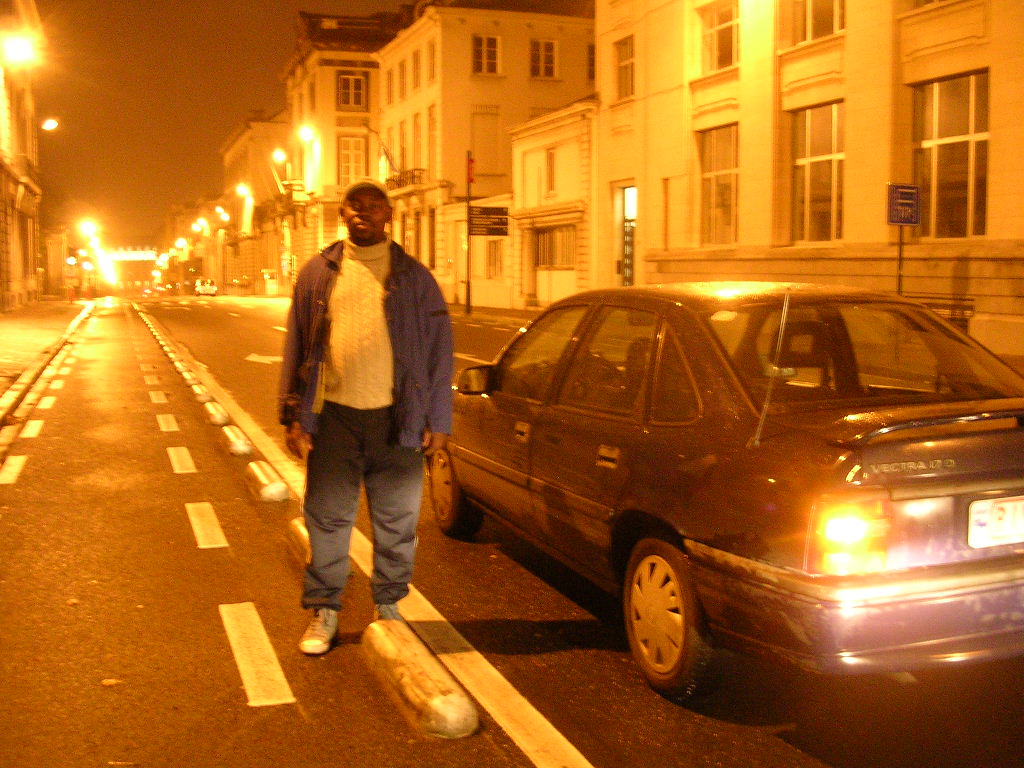
(DP Lino in Brussels, capital of Europe, serving the
worlds biggest institutions. Here in front of the
Belgian Parliament at 4 AM)

Always at round in the deserted capitals of the world, living of cheap coffee (not Red Bull, too expensive) and junkfood from the night shops, in the worst imaginable sorts of weather, to be able to go at home around 7 AM after having digested the morning traffic jams, often to go


(Delivery of the Wall Street Journal, the Financial Times, The Times, to companies and institutions around the Brussels stock exchange)


to a second job in the early afternoon, before returning to the nightly newspaperworld again


(Night manager Luc in a Brussels warehouse preparing
newspaper tours for his drivers. Most of them are Congolese.
They will come in around 02.45 AM, they will sticker their
newspapers with addresslabels while discussing the
political situation in Congo)

that same evening. I have a deep respect for our People of the Night, without them my job would be meaningless, our customers, both readers and advertisers, wouldn't be served. They run what I call a 'preparation economy' during the night. Every action they undertake serves a higher goal during the day. They ship, handle, pack and label products, the essence being 'creation of movement' so our daytime economy wouldn't come to a standstill because lack of products or information.

Thursday, November 02, 2006

week 44 - a few days in the Ardens -
Pareto/Zipf distribution

Picture: 11-01, Ortho-Mousny, Ardens, Belgium, 20 km from La Roche

The best known manifestation of Pareto/Zipf distributions is the 80/20 Rule, which is often used to explain that 20 % of products count for 80 percent of revenues, or 20 percent of our time accounts for 80 percent of our productivity, or any number of other comparisons that all share this characterisitic of a minority having disproportionate impact.
(Chris Anderson, The Long Tail)

Wednesday, October 25, 2006

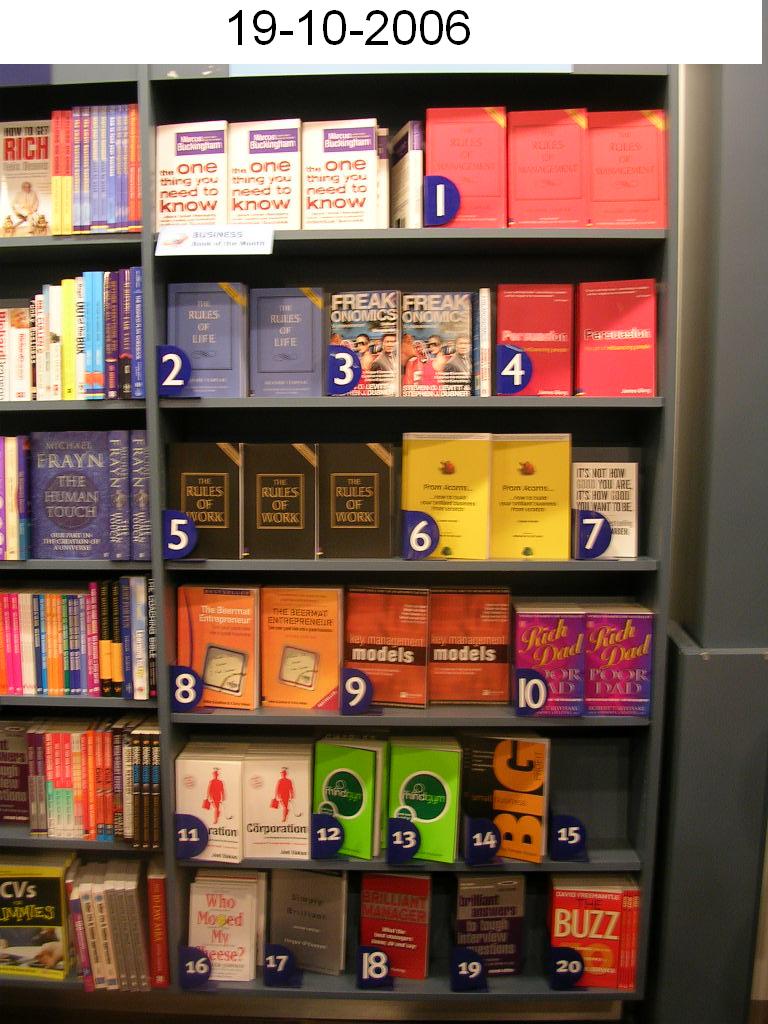
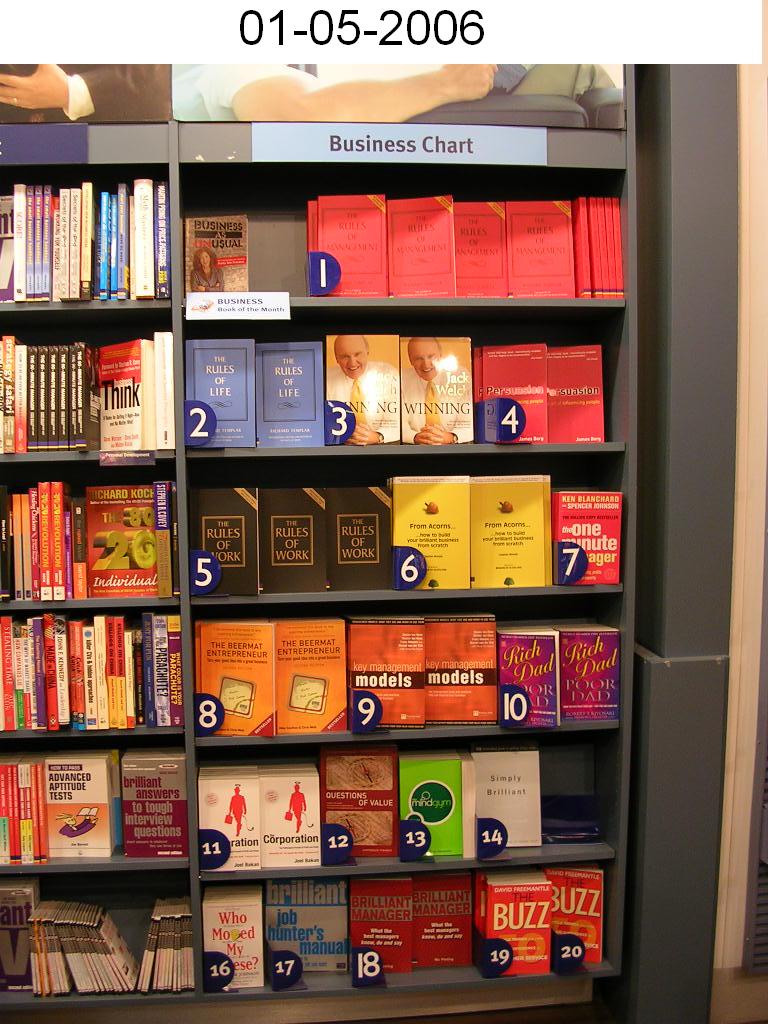
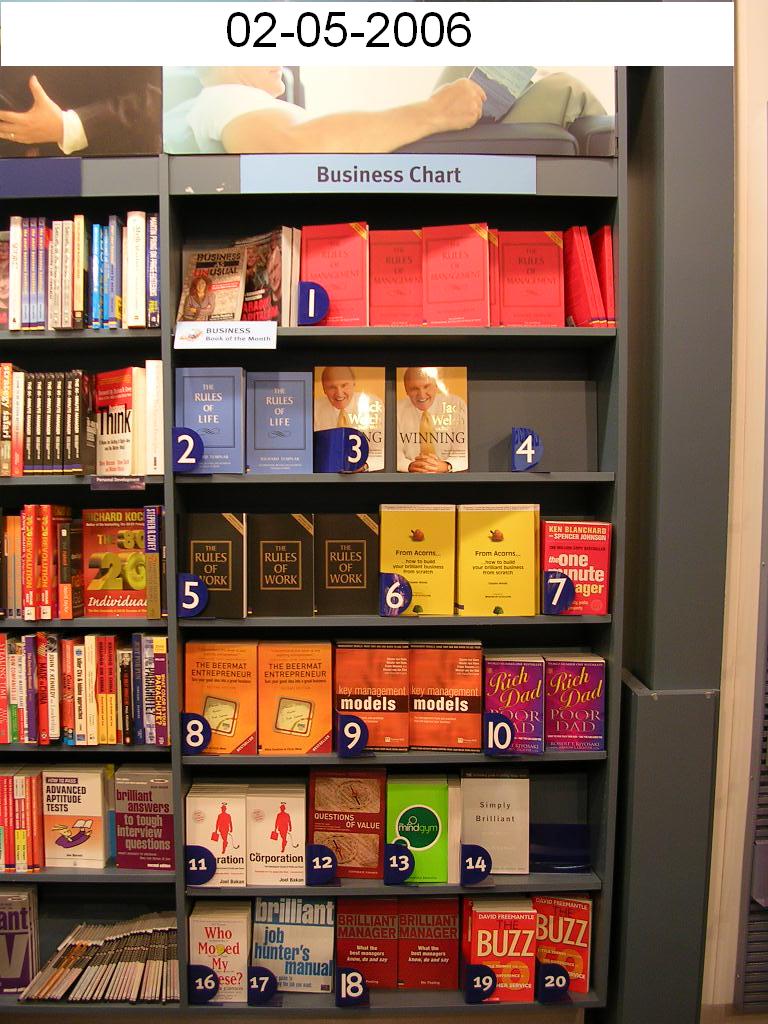
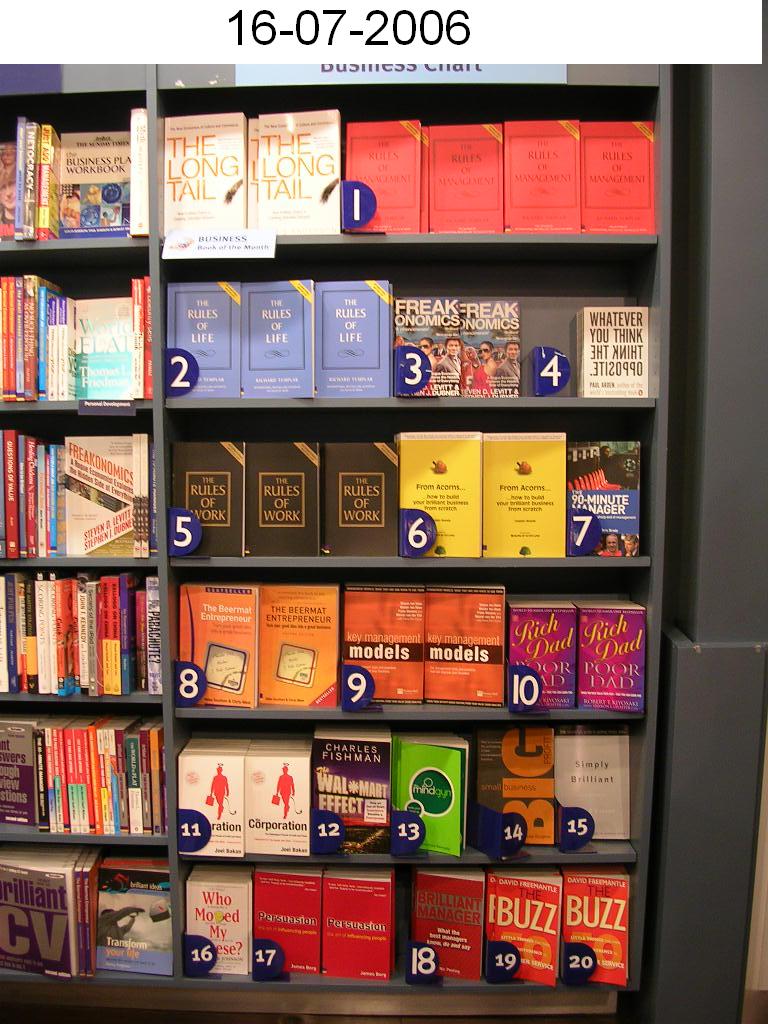
London City Airport Bookstore - Business Chart

Whenever I arrive at London City Airport I have to go to the public area Bookstore at ground level (there's only one). I guess most readers know by now I have a weakness for books in general, management books in particular. So I can't help myself but to check out which book the store manager put on nr 1 position, nor can I wait to see which book actually generated some sales between my visits. The past couple of months 'Winning' from Jack Welch or 'Freakonomics' from Steven Levitt and Stephen Dubner seem to stand out in sales.

I also like to wait a bit between the detectives and the historic novels, from where you have an excellent but somewhat hidden view on the Business Charts to check out who is buying the management books (it is also the perfect place from where to take a quick picture with a digital camera -amateur results see below- without being noticed or reprimanded by smiling yet unforgiving young African store clerks). The results speak for themselves. Buyers of business books are male, male, male (I have never ever seen a woman buy a management book). The younger buyer is around his thirties and wears a smart costume. He is to become the next CEO of the company he works for. The older buyer is around his late forties, begin fifties and wears a shabby costume. He always dreamt of the CEO position in one of the companies he worked for. Recently he became self-employed because he was a victim of a rationalization round in his last company.


Friday, October 20, 2006

Following New Trader Magazine to its UK Market

I followed the first issue of Trader magazine produced and co-published by Dow Jones, from the Belgian printplant to the UK market. More than 50.000 traders working in the financial district of London will receive their personal copy this week.


It is by all means a fantastic magazine, brilliantly targeted to high potentials with unearthly high incomes and spending habits.


Distribution in the heart of London to the worlds biggest financial conglomerates, grouped around Bishopsgate or Canary Wharf is an art on its own.
Magazines are transferred from dark underground loading docks protected by grim looking guards, via shabby elevators to marble led corridors and design lit reception area's, operated by stunning receptionists drawn from tv commercials.

I had the privilege of accompaning Jimmy and Diane, a couple that lives from distributing newspapers and magazines to this schizophrenic world day by day, never in bed before 4 AM, to be at work again before noon time. (They have 1 client they are really proud of, Downing Street 10, the house of the prime minister, who wants all major UK newspapers delivered to his door within 15 minutes after printing)


London, Canary Wharf, after work drink


Canary Wharf, Financial District,
(left: Reuters builing)

Tuesday, October 17, 2006

Albrecht on outsourcing war (7)

By writing about Albrecht I stumbled upon his recently created personal blog (http://www.partlybakedideas.blogspot.com). The blog shows 'off-beat, off-the-wall, partly-formed, embryonic snippets of ideas, offered solely for their curiosity value'. One of his off-the-wall ideas is to outsource war.

"Business experts are fond of advising companies to "outsource" - i.e. have somebody else do - everything but their "core competencies." This has led to a global shake-out as various business functions get outsourced to countries (and companies in those countries) who are able to do it cheaper (and sometimes better).This leads to an intriguing proposition: all countries could outsource their warmaking efforts to the United States. After all, the US is clearly the leading military force in the world, with the latest technology and the most highly trained, expert fighters. No other country makes war as well as the US does. If all countries outsourced their warmaking to the US, they could be sure of getting the best operations for their money.

Where would this lead? For one thing, the country willing to put up the most money would always win, because both sides would be buying military operations of identical quality.The drawback, one might say, would be that Americans would be fighting against each other. But, if the best-funded side would always win, then Americans could simply scale down the battles to make sure the right sponsor won, but with minimum casualties - and higher profits. In the end, maybe the wars could be fought with computers, and the losing side would have to pay money to the winning side. Would this work?"

Monday, October 16, 2006

Albrecht: 3 things leading to organizational intelligence (6)

Question: If an organization could do just three things to channel individual and team potential into organizational intelligence what would you recommend?

Karl Albrecht: "The best way is for the senior leaders of the organization to start thinking and talking about their enterprise as a potentially intelligent operation, and to undertake a never-ending assessment of its possibilities for advancement. There should be an ongoing conversation around the simple question: "How can we operate more intelligently?"

The second step is to start giving people the authority to think. When even the lowliest worker believes that his or her ideas, experiences, insights, and suggestions will be listened to and appreciated, we begin to liberate more of the tremendous brainpower that we've already hired - and that we're already paying for every payday.

The third step is a systematic, relentless, and never-ending attack on the causes of collective stupidity: organizational structures that don't make sense; "silos" that have grown up between departments or factions; policies, rules, and procedures that thwart the value-creation process; incompetent, ineffective, or failing managers; turf wars between managers and departments; union-management conflict; caste systems that have grown up in the organization; top-management behaviors that confuse, divide, or demotivate people; unfair or unjust
treatment of employees that destroys morale and the sense of shared fate; and, sometimes, even the lack of a clearly defined vision and mission.

The most intelligent organizations operate on the principle that 'good is never good enough'."

Friday, October 13, 2006

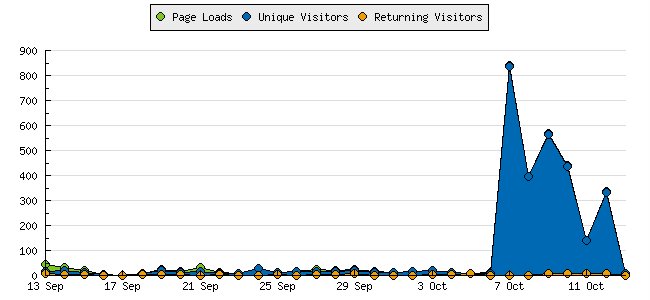
Impactroom Readership Explodes


I have no idea how nor why it happened, but suddenly the Impactroom blog started receiving serious numbers of visitors. From an average of 30 visitors a day readership exploded to nearly 900 visitors last Saturday. The graph shows a decline after the initial peak, but still, some 3000 visitors in 1 week, that's quite spectacular for a blog this size. All the visitors are coming from the US, that makes it more mysterious. On top of that the visitors come from all over the US, the readership is not concentrated at all. If anyone has an idea what could have happened, don't hesitate to contact me. Thank you all for the tremendous support and interest.

Thursday, October 12, 2006

Albrecht's Law: Examples of Successful Organizational Intelligence and Collective Stupidity (5)

An example of an organization that suffered from 'collective stupidity':
Karl Albrecht: "One of the most legendary episodes of collective stupidity was with Ford Motor Company in Detroit. In the early 1980s, they launched a new advertising program with the slogan "No unhappy owners." The TV ads promised that every Ford owner would have a car he or she was happy with, and if there was anything wrong, the company would make it right. The only problem was that they neglected to tell several thousand dealers about the ads. The dealers were swamped with unhappy owners, who became more unhappy when the dealers couldn't handle the volume of traffic.
This is the quintessential case of what I call "ballistic podiatry," otherwise known as shooting one's self in the foot."

An example of an organization that successfully utilized Organizational Intelligence:
Karl Albrecht: "On the opposite side, one of the legendary examples of collective intelligence, which has been going on for many years, is the remarkable orchestration of the daily experience of magic in the Disney theme parks. From the recruitment, indoctrination, training, placement, and supervision of the employees, all the way to the design and maintenance of the facilities, the delivery of customer value expresses the Disney business model, which is "fun and fantasy in a theatrical setting." Disney designers and managers are some of the world's best experts at eliminating the contradictions to the core proposition of value."

Wednesday, October 11, 2006

Albrecht on Imagination (4)

What importance does human imagination play in the overall success of an organisation?
Karl Albrecht: In all of the developed economies, organisations are shifting from "thing-work" to "think-work." This applies to government and the non-profit sector as well as the corporate sector. In the knowledge economy, fewer and fewer people make their living by making things, and more of them make their living by working with data, information, and knowledge. This means that practical thinking skills - including imagination, but certainly not limited to that - will be ever more in demand.

HR experts predict an increasingly severe "smart gap," meaning that we'll have a tougher time finding employees who can think beyond their noses. Inasmuch as the public education systems are failing miserably to provide us with the smart people we need, we will find it necessary to grow our own smart people. I believe more and more organisations will take up the role of educator of last resort, and invest more heavily in the mental competence of their workers.
At a time when companies are spending tens of millions of dollars on information technology - the machine software - they've so far not seen fit to spend a few tens of thousands of dollars on improving the mental skills of their employees - the human software. As we begin to realize how much of the IT investment is being wasted or misdirected, I believe we'll be spending less on the machine software and more on the human software.

Tuesday, October 10, 2006

Karl Albrecht, the WASM and the 7 components of Organizational Intelligence (3)

"The WASM"
According to the training manual of a restaurant chain that espoused the WASM, the manager should first explain to the employee what a WASM is and why it is important to be able to give one. Then the manager should say, "Now I'm going to demonstrate a WASM," after which he would WASM the employee. "Now it's your turn. Please demonstrate a WASM for me" after which the employee should WASM the manager.
Now that your curiosity is piqued, a "WASM" is "a warm and sincere smile."

As long as we give employees the impression that thinking of any sort is not allowed, Organizational Intelligence (OI) is not a possibility. Albrecht arguments that management needs to think of and treat employees as the self-motivated adults they are. And that's what the 7 components of OI spell out. Strategic vision is the sense of purpose and direction of the organization. Performance pressure includes the basics to get there: performance goals, clear roles and responsibilities, and feedback. Alignment and congruence are structural in nature and include structures that are appropriate to the mission and priorities, yet empowering and enabling employees to get their jobs done. Shared fate is the "we're all in this together" feeling--that everyone is treated as and feels as a valued member of the organization. Knowledge deployment is the flow of information into and around the organization. It includes cultural and structural elements to encourage and allow this to happen. Appetite for change is the culture of continuous improvement. With these pieces in place, then the valued and valuable employees who have a clear understanding of the direction, who understand their role in achieving that goal and feel that they have the freedom to get their job done, who can get the information they need, and even change the organization if needed, can provide the heart. Heart is commitment to the organization accompanied by the motivation to move the entire company ahead. It goes beyond just doing one's own job (or even doing it well).

Monday, October 09, 2006

Albrecht's Law of Collective Stupidity (2)

Albrecht believes that smartness can be learned, just as dumbness is learned. He defines organizational intelligence (OI) as "the capacity of an organization to mobilize all of its brain power, and focus that brain power on achieving the mission." There are seven organizational components of organizational intelligence (OI). These are:

- strategic vision
- appetite for change
- alignment and congruence
- performance pressure
- knowledge deployment
- heart
- shared fate

Many managers have an unconscious belief about workers or employees as being separate from, and maybe not quite as good as, "the organization." To this day, many of our OI practices and assumptions, and many management practices, may still be based on the assumption that employees are basically interchangeable parts of a production machine.
Albrecht thinks this belief impacts OI. He suggests that this belief can be traced back to Taylor, the Father of Scientific Management (Frederick Winslow Taylor 1856 - 1915) who concluded two things from his studies. First, that work procedures were inefficiently designed and second, that the fundamental motivation of hired workers was to do the least amount of work as possible. Further, Taylor is quoted as saying, "Most executives want workers who are house-broken. They talk a good game about wanting highly motivated employees who can add value, but when it comes down to particulars they really value obedience. Many executives are threatened by smart people below them."

Albrecht argues that these believes are somehow still to be found in companies today. He gives many examples of this happening in businesses that he is consulting with currently. It occurs on many different levels. It can be just the way management refers to employees as "a resource" (which according to Albrecht is patronizing and trite). At its worst, Albrecht calls it the "rabble hypothesis" or the view of employees as the "great unwashed: unintelligent, unmotivated, socially naive, and incapable of original thought."

Friday, October 06, 2006

Albrecht's Law: “Intelligent people, when assembled into an organization, will tend toward collective stupidity.” (1)

In the early morning hours of September 30, 1999, NASA’s Mars climate orbiter spacecraft, a $125 million marvel of engineering, designed to orbit Mars, suddenly disappeared from the screens of mission control and, seconds later, its signal vanished for ever. An investigation of this incident revealed that the NASA engineers who wrote the navigation software for the orbiter had been working in separate groups and had apparently not approached the mission as a whole. In fact, one group had been programming its calculations using metric units – kilometers and kilograms – while the other had been relying on American style English units – miles and pounds. That led to the critical flaw in the orbiter’s navigation. It inevitably burned to crisps due to friction with the atmosphere of Mars.

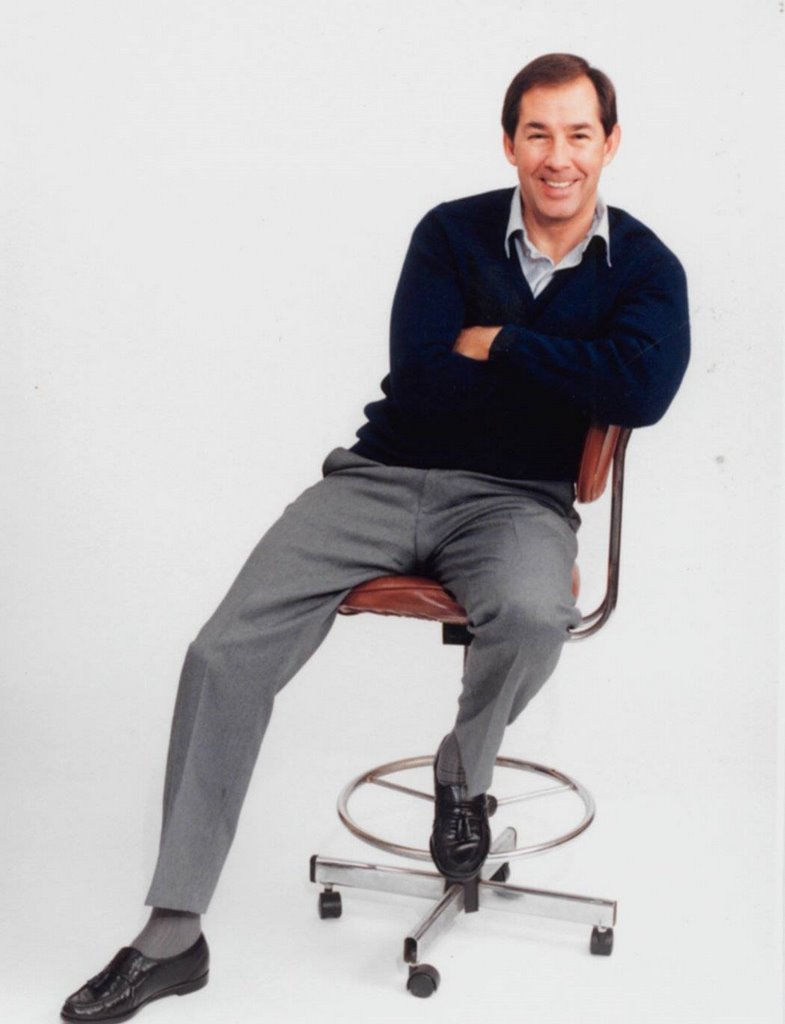
In his book “The Power of Minds at Work”, Karl Albrecht (picture) cites this case as an example for what is been known now as Albrecht’s law: “Intelligent people, when assembled into an organization, will tend toward collective stupidity.”

Arguing that in organizations, the sum of all individual minds only rarely equals the level of organizational intelligence, he identifies several factors that may contribute to this dysfunction. Based on more than 25 years’ experience as a consultant, Albrecht contends that organizational “entropy” (that is, the energy of a system that remains unavailable for conversion to work), ineffective decision-making processes, and cultural clashes arise in every organization. With employees working in separate departments, each department protecting its turf and often not knowing what the others are doing, “collective brain power gets wasted,” Albrecht says, thus compromising the mission of the enterprise. Collaboration and knowledge management, the two major buzzwords of today’s enterprise, may work on academic paper but are far from being effectively applied in practice.

Tuesday, October 03, 2006

Concepticide

So many managementtheories, so many managementconcepts. A Dutch PhD, Stefan Heusinkveld (2005) invented the word 'concepticide' to illustrate the risk of loosing valuable management knowledge by jumping from one concept to another. Managers tend to listen to guru's, consultants, agents, evangelists, colleagues and professors in search of the best possible management concept to help understand their business. Bringing management concepts to the market however has become a profitable business on its own. The concepts are marketed aggressively. There is no doubt that there is something valuable in every new born concept, helas by constantly switching concepts, a lot of knowledge becomes obsolete in the mind of the manager. A concept has a lifespan no longer than any other fashionable object. According to the research of the PhD managers are not capable of systematically enlarging their management knowledge base. Instead of building, layer upon layer, a formidable management 'knowledge castle', managers tend to reinvent the wheel over and over again... allowing mistakes to resurface, or rediscovering knowledge already available from the past.

Friday, September 29, 2006

He who builds a museum must truly be a leader.

My old professor in Sports History, Prof.Dr.R.Renson always dreamt of a professional Sports Museum. After years of hardship he finally succeeded in creating probably one of the most interesting museums in the Benelux. He who builds a museum from scratch must truly be a leader, and most certainly a people manager.
Truth is, it was not the collection nor one outstanding object that took me by surprise. It were...the toilets.


(Don't hesitate to visit the museum, Sportimonium, Hofstade, Belgium and especially the unique Flemish Folk Games Garden)(www.sportimonium.be)