 I am a big fan of the Guardian. Especially the media section on Mondays is a treat. The weekly poster supplements are very attractive tools to children (and grown ups!). A subscription to the Guardian is an excellent gift to start 2007 with.
Tuesday, December 26, 2006
New Impactroom Partner - Subscribe to the Guardian or The Observer :-)
I am a big fan of the Guardian. Especially the media section on Mondays is a treat. The weekly poster supplements are very attractive tools to children (and grown ups!). A subscription to the Guardian is an excellent gift to start 2007 with.


Saturday, December 23, 2006
Merry Christmas!! 6 Christmas Quotes

(Churchil Hotel London, preparing for an overseas meeting)
"Let's be naughty and save Santa the trip." (Gary Allan)
“One of the nice things about Christmas is that you can make people forget the past with a present” (anonymous)
“Christmas is the time when kids tell Santa what they want and adults pay for it. Deficits are when adults tell government what they want and their kids pay for it.” (Richard Lamm)
“From a commercial point of view, if Christmas did not exist it would be necessary to invent it.”
(Katherine Whitehorn)
“Christmas is the Disneyfication of Christianity” (Don Cupitt)
“Christmas gift suggestions:
To your enemy, forgiveness.
To an opponent, tolerance.
To a friend, your heart.
To a customer, service.
To all, charity.
To every child, a good example.
To yourself, respect.”
(Oren Arnold)
Friday, December 22, 2006
ACE lunch 2006 London
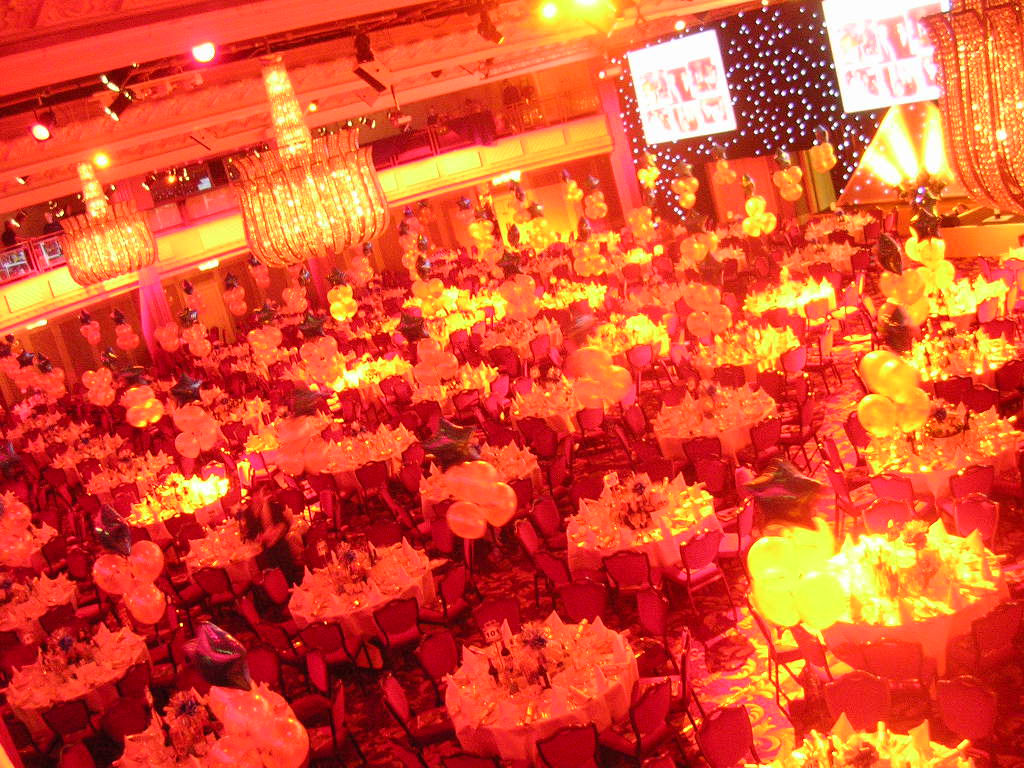
ACE – the Association of Circulation Executives – is a UK association of like-minded executives drawn from the fields of newspaper and magazine publishing, news wholesaling and distribution and service provision.
One of the most popular events of the ACE calendar is the ACE Christmas Luncheon held at the Grosvenor House hotel in London. More than 1,100 members and guests enjoy a truly international publishing event whilst raising funds for charity.
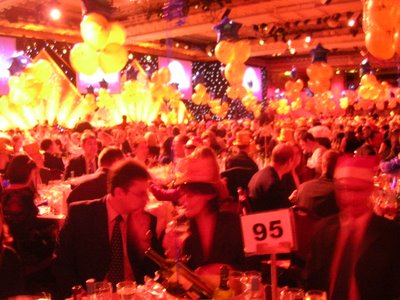
To my surprise the lunch involved a lot of standing up, praying, hailing kings and queens, singing (hand in hand) and wearing stuff on your head you couldn't afford be seen with in continental Europe. A truly bizar, though warm, very very British event (not surprisingly the goal of the organization, founded in 1951, clearly states: ...to foster fellowship, friendship, and the exchange of ideas between members of our industry.)
This is networking to good effect.
Thursday, December 21, 2006
Oxford
Oxford, (OMEC meetings). A few impressions.

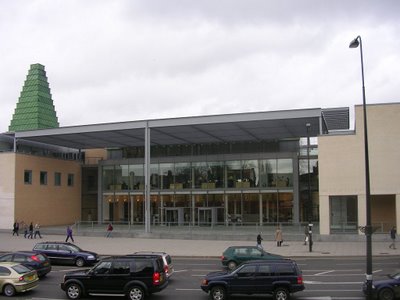 Saïd Business School (SBS)
First big building leaving the train station at Oxford. SBS is the business school of the University of Oxford. After a gift of £20 million from Wafic Saïd in 1996 the former 'University of Oxford School of Management' became the Saïd Business School. (The gift was contested by Oxford students at the opening of the new building in 2001 - after an extra donation of £3 million for constructing the building-. The students claim Saïds fortune comes from questionable armaments deals between UK and Saudi Arabia.)
The MBA programme ranked 20th worldwide and 2nd in the UK in the Financial Times Global MBA Rankings 2006.
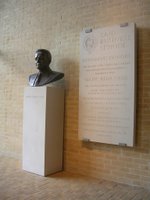 Wafic Riad Saïd
A Syrian businessman(1939) who became a multi-millionaire working for the Saudi Royal Family as a consultant in the fields of infrastructure and armaments projects.

Saïd Business School entrance
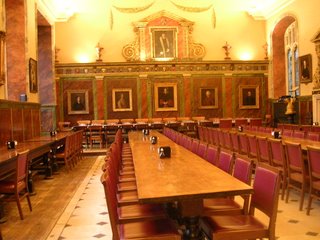
Dining hall, Trinity College
One of the smaller (ca. 300 students) of the 39 colleges at Oxford admitting students for degree courses (1555).
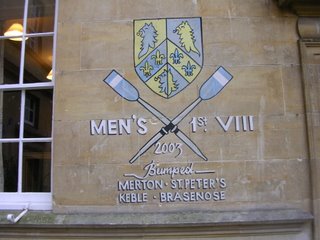 Student house at Trinity College, rowing team.
 English breakfast, while contemplating the idea of building a future leadership academy or institute out of OMEC
 Christ Church
A unique institute with a dual function. On the one hand it is one of the largest colleges in the University of Oxford. On the other hand it is also the church for the Diocese of Oxford. The Cathedral still follows the old Oxford Time which is five minutes west of Greenwich. (6 p.m. Oxford time is 6.05 p.m. GMT). Every day at '6' the Cathedral Choir will sing in the church.
Tuesday, December 12, 2006
Top Business Schools in Europe - Where To Get Your Top MBA
I picked up a copy of 'City to Cities' at City Airport London recently. In the glossy there was an article about the best business schools in Europe. Here is the ranking:
1. London Business School, UK. Ranked nr 1 in the Financial Times top ten business school listing. MBA tuition fees: 42.500 £. http://www.london.edu
2. Insead, Paris/Fontainbleau, France. Executive MBA tuition fees: 85.000 €. http://www.insead.edu
3. HEC, Paris, France, l’Ecole des Hautes Etudes Commerciales. EMBA tuition fees: 41.200 €. http://www.hec.fr
4. Cass Business School, City University, London, UK. The EMBA was ranked third-best in Europe by the FT. EMBA tuition fees: 31.000 £. http://www.cass.city.ac.uk
5. Otto Beisheim School of Management, Frankfurt, Valladur, Germany. Linked with Northwestern Kellog School of Management, USA. Named after billionaire Otto Beisheim, owner of Media Markt. EMBA tuition fees: 57.000 €. http://www.whu.edu
6. Vlerick Leuven Gent Management School, Leuven/Gent, Belgium. Stats show it is the number one global school for graduates gaining employment within three months. Part-time MBA tuition fee: 19.000 €. http://www.vlerick.be
7. Instituto Empressa, IE, Madrid, Spain. Is considered a 'high pressure' school. EMBA tuition fees: 41.000 €. http://www.ie.edu
8. SDA Bocconi School of Management, Milan, Italy. Milans's Bocconi University is the country's top business college and the School of Management its top graduate business school. Part-time EMBA fees: 28.000 €. http://www.sdabocconi.it/md
Did you study at one of these fine universities ? Do you agree with above ranking ?
Thursday, November 30, 2006
10 remarkable points to remember Friedman by (5/5)
Milton Friedman (31/07/1912 – 16/11/2006)
 1. 20th century economics showed 2 major important economical schools: the ‘Keynesian economics’, an economic theory based on the ideas of John Maynard Keynes, and ‘Monetarism’ a theory largely attributed to Milton Friedman.
2. Friedman attacked Keynes beliefs in the 1950’s in his book ‘A Theory of the Consumption Function’. But Friedman acknowledged the fact that even he started out as a Keynesian. “We all use the Keynesian language and apparatus; none of us any longer accepts the initial Keynesian conclusions", he says.
3. Keynes says the economy is best served by government and parliament. They have to regulate the economy via taxes and government spending. Friedman and the monetarists on the other hand argue government should not interfere with economy at all. The economy should be left to the people and the companies. Exceptionally central banks can interfere and influence the economy through regulation of the quantity of money. Monetarists speak of ‘laissez-faire economics' (economic theory based on the belief that markets and the private sector could operate well on their own, without state intervention).
4. According to Keynes (1957) individual consumption depends on wages, and therefore it is an unstable parameter. Increase in wages leads to more consumption, dismissals lead to decreased consumption. Friedman does not agree: it is the ‘income-expectation on long term’, the so called ‘permanent income hypothesis’ that influences consumption. It means that consumers will spend not driven by their current income, but by their long term income expectations. Individual consumption is therefore a much more stable parameter.
5. Keynesians argue that the quantity of money should not be considered as a reliable economical instrument because the circulation speed of money is not constant. Friedman however proved that the money velocity as well as money production is constant. This means that the quantity of the money determines price setting and the level of inflation (the supply of money being larger than the demand for money). The inflation is to be regulated by controlling the amount of money poured into the national economy by the National Banks.
6. Nobel Price for Economic Science in 1976 for his work on consumption analysis and monetary theory.
7. Friedman played a remarkable role in the abolition of the draft in the 1970s in the U.S. He stated that his role in eliminating the draft was his proudest accomplishment.
8. Friedman was a Professor of Economics at the University of Chicago from 1946 to 1976. He created an intellectual community that produced a number of Nobel Prize winners, known as the 'Chicago School of Economics'.
9. Friedman co-wrote and co-produced ‘Free to Choose’ with his wife Rose D. Friedman. They also created the 'Milton and Rose D. Friedman Foundation', an organisation determined to introduce and promote schoolvouchers in the American schoolsystem as well as the freedom of choice in education. Their memoirs are published as ‘Milton and Rose D. Friedman, Two Lucky People’ (1998). Milton Friedman claimed that Rose was probably the only person in the world to have ever won an argument from him.
10. Milton Friedman was cremated. He wanted his ashes be scattered over the San Francisco bay.
Sunday, November 26, 2006
"There's no such thing as a free lunch" and other quotes from Friedman (4/5)
1. I am in favor of cutting taxes under any circumstances and for any excuse, for any reason, whenever it's possible.
2. I'm in favor of legalizing drugs. According to my values system, if people want to kill themselves, they have every right to do so. Most of the harm that comes from drugs is because they are illegal.
3. The most important single central fact about a free market is that no exchange takes place unless both parties benefit. 4. The most important ways in which I think the Internet will affect the big issue is that it will make it more difficult for government to collect taxes.
5. Inflation is caused by too much money chasing after too few goods.
6. On the difference between public vs. private education: "Try talking French with someone who studied it in public school. Then with a Berlitz graduate."
7. There's no such thing as a free lunch.
8. The problem of social organization is how to set up an arrangement under which greed will do the least harm, capitalism is that kind of a system.
9. The only way that has ever been discovered to have a lot of people cooperate together voluntarily is through the free market. And that's why it's so essential to preserving individual freedom.
10. The power to do good is also the power to do harm.
Wednesday, November 22, 2006
6 Quotes from Friedman about Government (3/5)
 1. Governments never learn. Only people learn.
2. Many people want the government to protect the consumer. A much more urgent problem is to protect the consumer from the government.
3. Only government can take perfectly good paper, cover it with perfectly good ink and make the combination worthless.
4. The black market was a way of getting around government controls. It was a way of enabling the free market to work. It was a way of opening up, enabling people.
5. President Kennedy said, "Ask not what your country can do for you - ask what you can do for your country."... Neither half of that statement expresses a relation between the citizen and his government that is worthy of the ideals of free men in a free society. "What your country can do for you" implies that the government is the patron, the citizen the ward. "What you can do for your country" assumes that the government is the master, the citizen the servant.
6. We have a system that increasingly taxes work and subsidizes nonwork.
Tuesday, November 21, 2006
Friedman on Freedom (2/5)
Friedman disliked regulations. The voluntary choices of individuals, not the dictates of the state, should be the default mode of human life. A government should protect her citizens. That’s it. That is her one and only duty. Friedman placed the choices of buyers and sellers, not government management, at the center of economical thinking. A government should not try to regulate the economy, nor try to govern morality, nor try to look after voters’ interests. A society led by a regulatory government will be less efficient, less innovative, and ultimately less free. The government should act like a referee, not as a player. "The government solution to a problem is usually as bad as the problem", Friedman says.
Monday, November 20, 2006
Milton Friedman dies at 94 (1/5)
4 ways to spend money by Milton Friedman
You spend your own money on yourself.
You spend your own money on someone else.
You spend someone else’s money on your own.
You spend someone else’s money on someone else.
Also read:
- IMPACTROOM for managers, marketeers and mothers*: Friedman on Freedom (2/5)
- IMPACTROOM for managers, marketeers and mothers*: 6 Quotes from Friedman about Government (3/5)
- IMPACTROOM for managers, marketeers and mothers*: "There's no such thing as a free lunch" and other quotes from Friedman (4/5)
- IMPACTROOM for managers, marketeers and mothers*: 10 remarkable points to remember Friedman by (5/5)
Wednesday, November 15, 2006
Who Becomes Great ? The 10-Year-Rule.
Geoffrey Colvin wrote an interesting article in Fortune Magazine this month: "What it takes to be great." Major conclusion of recent surveys is that nobody is great without work. It's nice to believe that if you find the field where you're naturally gifted, you'll be great from day one, but it doesn't happen. There is no evidence of high-level performance without experience or practice. Reinforcing that no-free-lunch finding is vast evidence that even the most accomplished people need around ten years of hard work before becoming world-class, a pattern so well established researchers call it the ten-year-rule.
(The ten-year rule represents a very rough estimate, and most researchers regard it as a minimum, not an average. In many fields (music, literature) elite performers need 20 or 30 years' experience before hitting their zenith.)
So greatness isn't handed to anyone, it requires a lot of hard work. Yet that isn't enough, since many people work hard for decades without approaching greatness or even getting significantly better. What's missing ? The best people in any field are those who devote the most hours to what the researchers call 'deliberate practice'. It is activity that's explicitly intended to improve performance, that reaches for objectives just beyond one's level of competence, provides feedback on results, and involves high levels of repetition. For example: Simply hitting a bucket of balls is not deliberate practice, which is why most golfers don't get better. Hitting an eight-iron 300 times with a goal of leaving the ball within 20 feet of the pin 80% of the time, continually observing results and making appropriate adjustments, and doing that for hours every day - that's 'deliberate practice'. Consistency is crucial.
Monday, November 13, 2006
People of the Night (Preparation Economy)
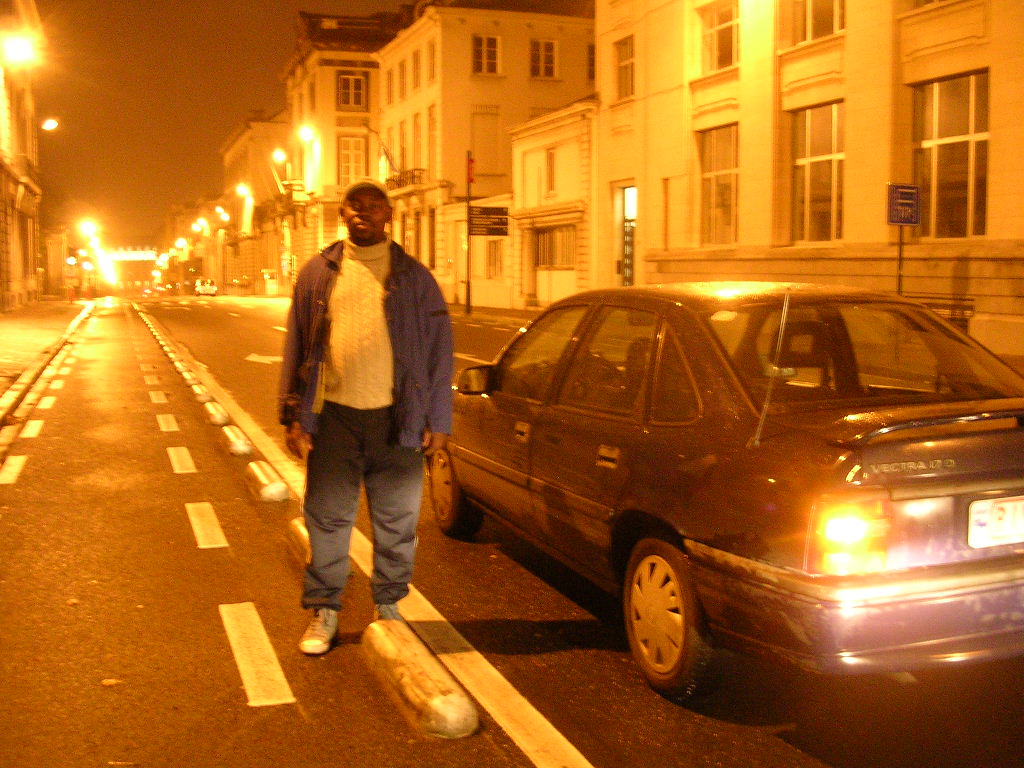
They are the people of the night, the DP's (delivery persons), the people that deliver the most sophisticated newspapers and magazines of the world to your door in the middle of the night. So that you, the reader, can read or at least go through the newspaper or mag before you go to work. The people of the night are at the bottom of the food chain in distribution country. There couldn't be a
 bigger difference in way of living between the DP's and the readers they serve.
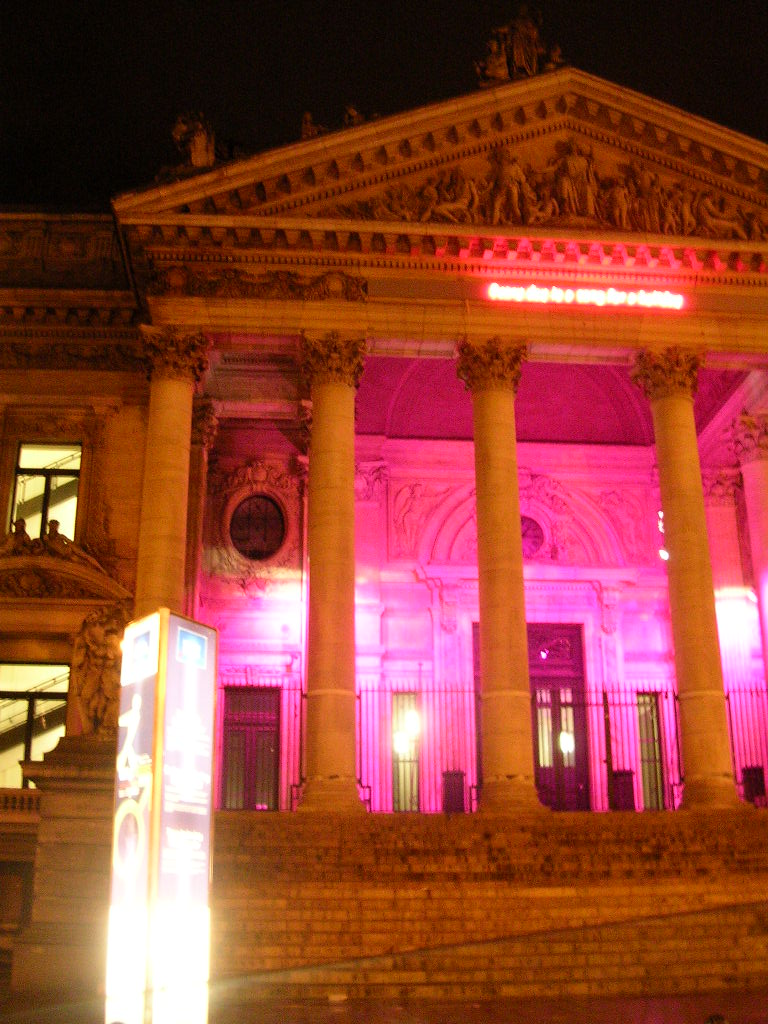
(DP Lino in Brussels, capital of Europe, serving the
worlds biggest institutions. Here in front of the
Belgian Parliament at 4 AM)
Always at round in the deserted capitals of the world, living of cheap coffee (not Red Bull, too expensive) and junkfood from the night shops, in the worst imaginable sorts of
 weather, to be able to go at home around 7 AM after having digested the morning traffic jams, often to go
(Delivery of the Wall Street Journal, the Financial Times, The Times, to companies and institutions around the Brussels stock exchange)
to a second job in the early afternoon, before returning to the nightly newspaperworld again
(Night manager Luc in a Brussels warehouse preparing
newspaper tours for his drivers. Most of them are Congolese.
They will come in around 02.45 AM, they will sticker their
newspapers with addresslabels while discussing the
political situation in Congo)
that same evening. I have a deep respect for our People of the Night, without them my job would be meaningless, our customers, both readers and advertisers, wouldn't be served. They run what I call a 'preparation economy' during the night. Every action they undertake serves a higher goal during the day. They ship, handle, pack and label products, the essence being 'creation of movement' so our daytime economy wouldn't come to a standstill because lack of products or information.
Thursday, November 02, 2006
week 44 - a few days in the Ardens - Pareto/Zipf distribution

Picture: 11-01, Ortho-Mousny, Ardens, Belgium, 20 km from La Roche
The best known manifestation of Pareto/Zipf distributions is the 80/20 Rule, which is often used to explain that 20 % of products count for 80 percent of revenues, or 20 percent of our time accounts for 80 percent of our productivity, or any number of other comparisons that all share this characterisitic of a minority having disproportionate impact.
(Chris Anderson, The Long Tail)
Wednesday, October 25, 2006
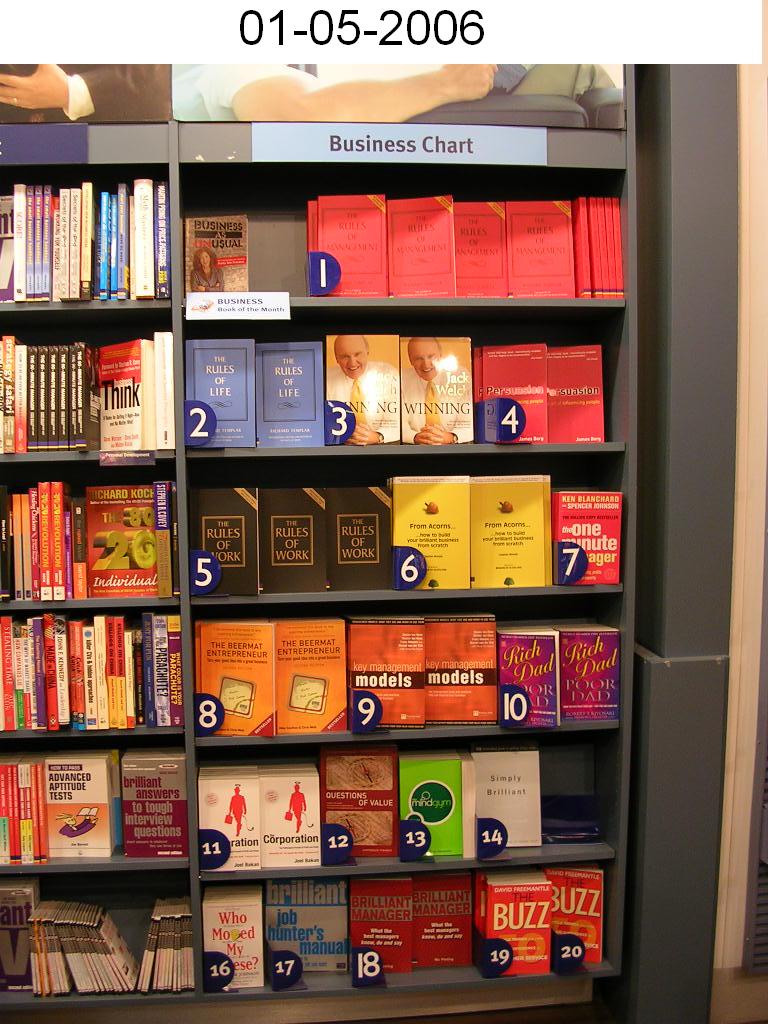
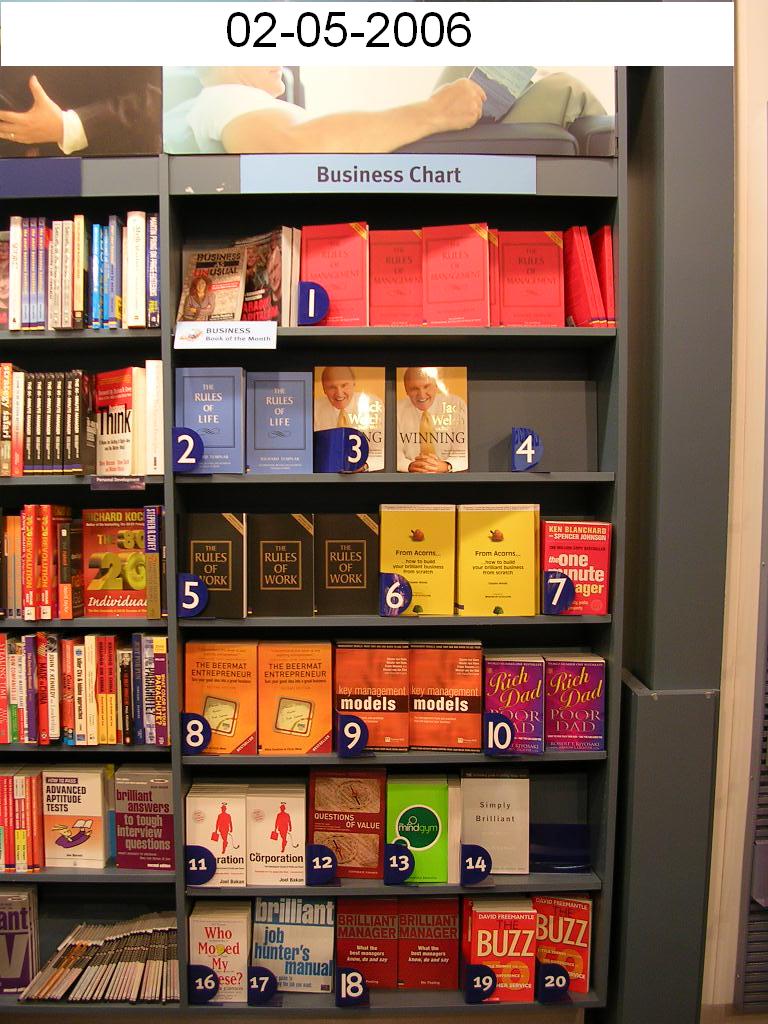
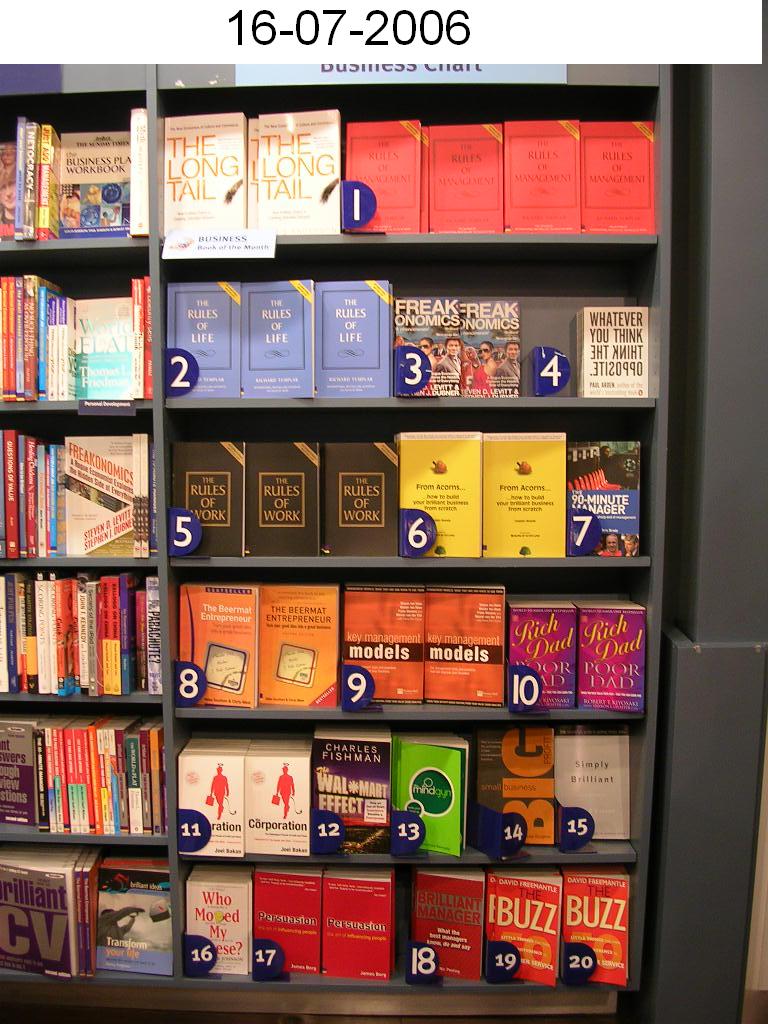
London City Airport Bookstore - Business Chart
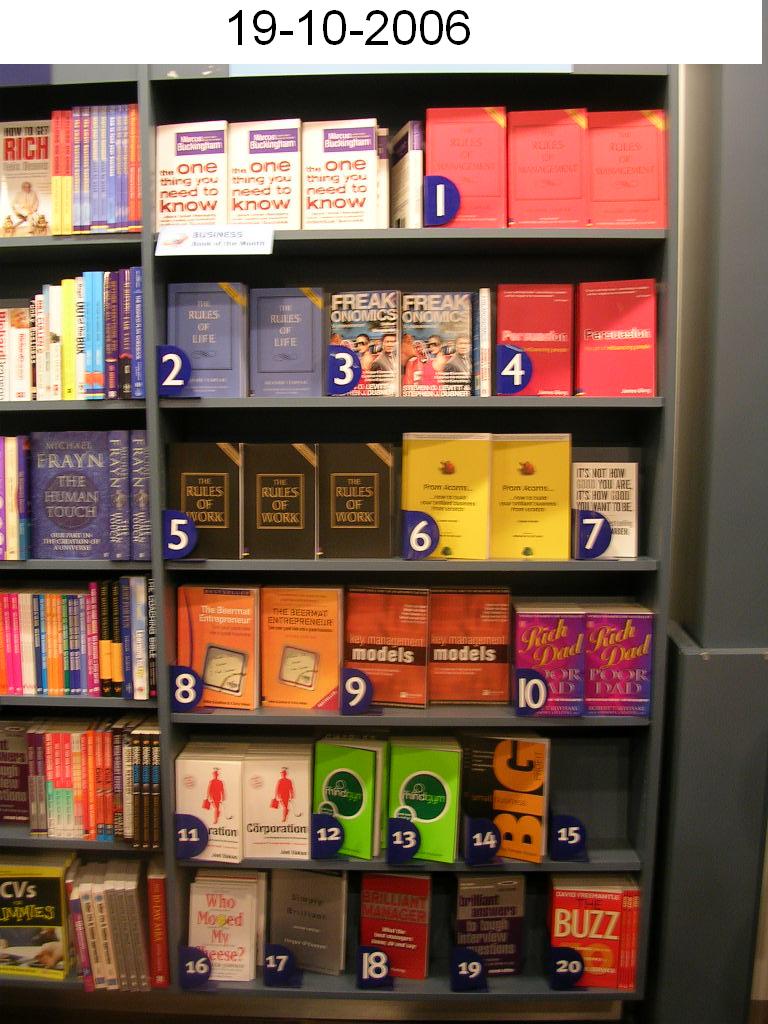
Whenever I arrive at London City Airport I have to go to the public area Bookstore at ground level (there's only one). I guess most readers know by now I have a weakness for books in general, management books in particular. So I can't help myself but to check out which book the store manager put on nr 1 position, nor can I wait to see which book actually generated some sales between my visits. The past couple of months 'Winning' from Jack Welch or 'Freakonomics' from Steven Levitt and Stephen Dubner seem to stand out in sales.
I also like to wait a bit between the detectives and the historic novels, from where you have an excellent but somewhat hidden view on the Business Charts to check out who is buying the management books (it is also the perfect place from where to take a quick picture with a digital camera -amateur results see below- without being noticed or reprimanded by smiling yet unforgiving young African store clerks). The results speak for themselves. Buyers of business books are male, male, male (I have never ever seen a woman buy a management book). The younger buyer is around his thirties and wears a smart costume. He is to become the next CEO of the company he works for. The older buyer is around his late forties, begin fifties and wears a shabby costume. He always dreamt of the CEO position in one of the companies he worked for. Recently he became self-employed because he was a victim of a rationalization round in his last company.


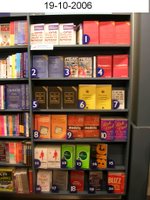
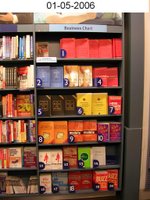
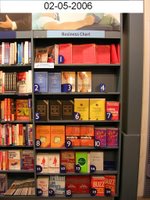


I also like to wait a bit between the detectives and the historic novels, from where you have an excellent but somewhat hidden view on the Business Charts to check out who is buying the management books (it is also the perfect place from where to take a quick picture with a digital camera -amateur results see below- without being noticed or reprimanded by smiling yet unforgiving young African store clerks). The results speak for themselves. Buyers of business books are male, male, male (I have never ever seen a woman buy a management book). The younger buyer is around his thirties and wears a smart costume. He is to become the next CEO of the company he works for. The older buyer is around his late forties, begin fifties and wears a shabby costume. He always dreamt of the CEO position in one of the companies he worked for. Recently he became self-employed because he was a victim of a rationalization round in his last company.



Friday, October 20, 2006
Following New Trader Magazine to its UK Market
 I followed the first issue of Trader magazine produced and co-published by Dow Jones, from the Belgian printplant to the UK market. More than 50.000 traders working in the financial district of London will receive their personal copy this week
 .
It is by all means a fantastic magazine, brilliantly targeted to high potentials with unearthly high incomes and spending habits.




Distribution in the heart of London to the worlds biggest financial conglomerates, grouped around Bishopsgate or Canary Wharf is an art on its own.
Magazines are transferred from dark underground loading docks protected by grim looking guards, via shabby elevators to marble led corridors and design lit reception area's, operated by stunning receptionists drawn from tv commercials.
I had the privilege of accompaning Jimmy and Diane, a couple that lives from distributing newspapers and magazines to this schizophrenic world day by day, never in bed before 4 AM, to be at work again before noon time. (They have 1 client they are really proud of, Downing Street 10, the house of the prime minister, who wants all major UK newspapers delivered to his door within 15 minutes after printing)
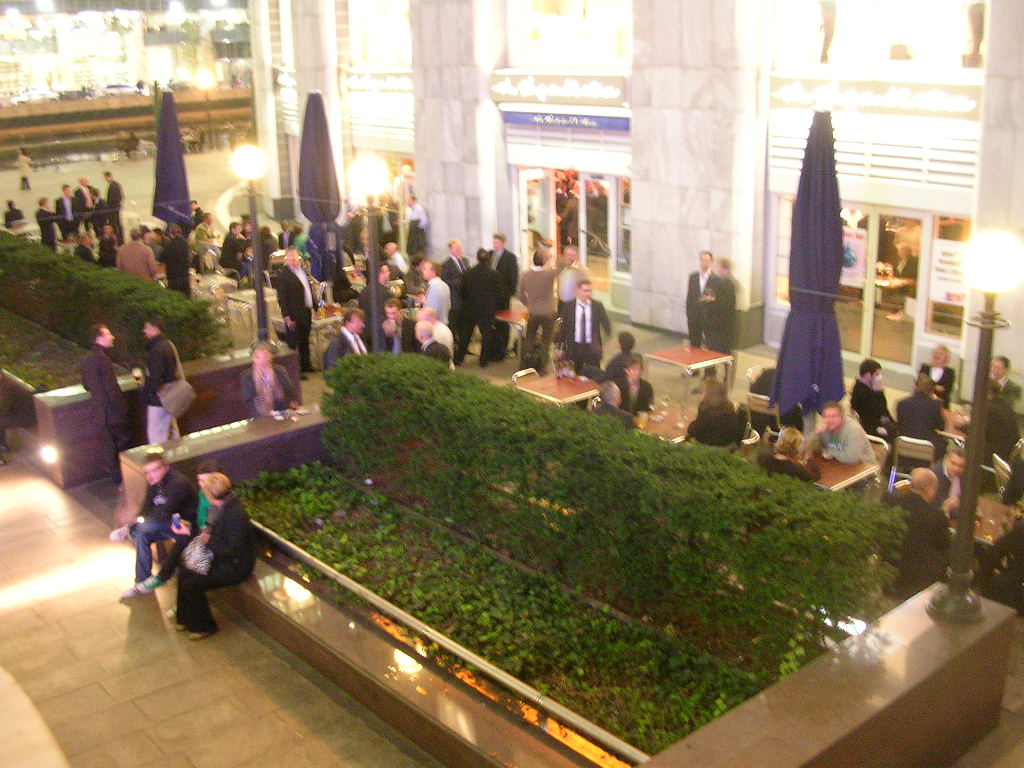
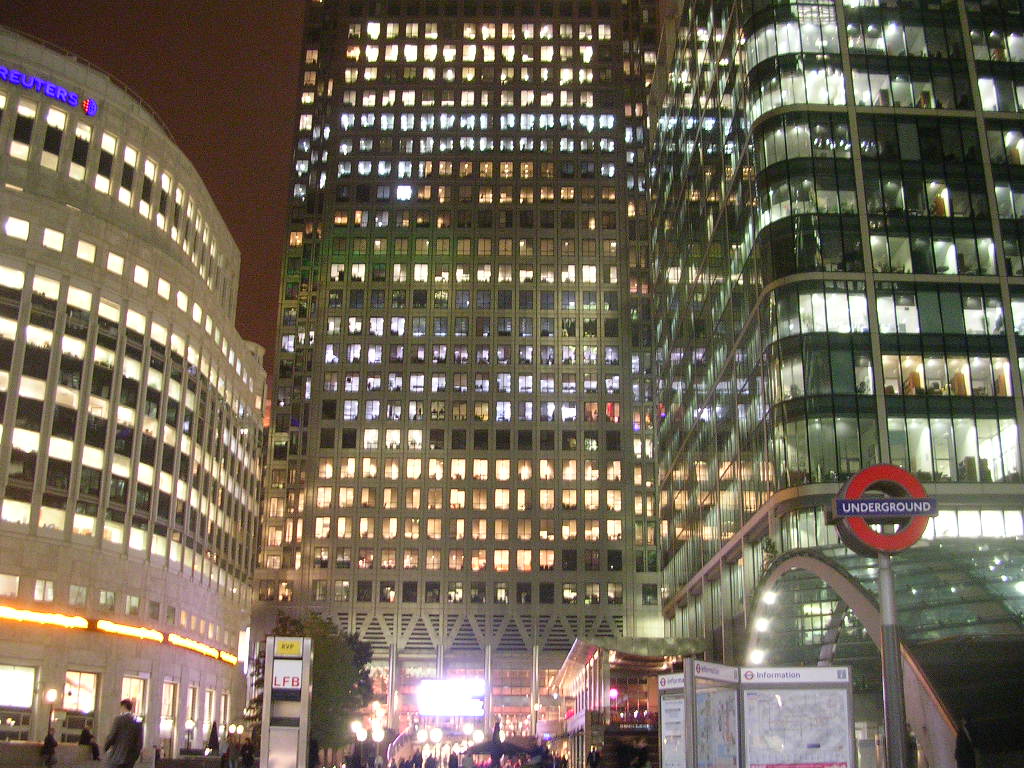
London, Canary Wharf, after work drink
Canary Wharf, Financial District,
(left: Reuters builing)
Tuesday, October 17, 2006
Albrecht on outsourcing war (7)
By writing about Albrecht I stumbled upon his recently created personal blog (http://www.partlybakedideas.blogspot.com). The blog shows 'off-beat, off-the-wall, partly-formed, embryonic snippets of ideas, offered solely for their curiosity value'. One of his off-the-wall ideas is to outsource war.
"Business experts are fond of advising companies to "outsource" - i.e. have somebody else do - everything but their "core competencies." This has led to a global shake-out as various business functions get outsourced to countries (and companies in those countries) who are able to do it cheaper (and sometimes better).This leads to an intriguing proposition: all countries could outsource their warmaking efforts to the United States. After all, the US is clearly the leading military force in the world, with the latest technology and the most highly trained, expert fighters. No other country makes war as well as the US does. If all countries outsourced their warmaking to the US, they could be sure of getting the best operations for their money.
Where would this lead? For one thing, the country willing to put up the most money would always win, because both sides would be buying military operations of identical quality.The drawback, one might say, would be that Americans would be fighting against each other. But, if the best-funded side would always win, then Americans could simply scale down the battles to make sure the right sponsor won, but with minimum casualties - and higher profits. In the end, maybe the wars could be fought with computers, and the losing side would have to pay money to the winning side. Would this work?"
Monday, October 16, 2006
Albrecht: 3 things leading to organizational intelligence (6)
Question: If an organization could do just three things to channel individual and team potential into organizational intelligence what would you recommend?
Karl Albrecht: "The best way is for the senior leaders of the organization to start thinking and talking about their enterprise as a potentially intelligent operation, and to undertake a never-ending assessment of its possibilities for advancement. There should be an ongoing conversation around the simple question: "How can we operate more intelligently?"
The second step is to start giving people the authority to think. When even the lowliest worker believes that his or her ideas, experiences, insights, and suggestions will be listened to and appreciated, we begin to liberate more of the tremendous brainpower that we've already hired - and that we're already paying for every payday.
The third step is a systematic, relentless, and never-ending attack on the causes of collective stupidity: organizational structures that don't make sense; "silos" that have grown up between departments or factions; policies, rules, and procedures that thwart the value-creation process; incompetent, ineffective, or failing managers; turf wars between managers and departments; union-management conflict; caste systems that have grown up in the organization; top-management behaviors that confuse, divide, or demotivate people; unfair or unjust
treatment of employees that destroys morale and the sense of shared fate; and, sometimes, even the lack of a clearly defined vision and mission.
The most intelligent organizations operate on the principle that 'good is never good enough'."
Friday, October 13, 2006
Impactroom Readership Explodes
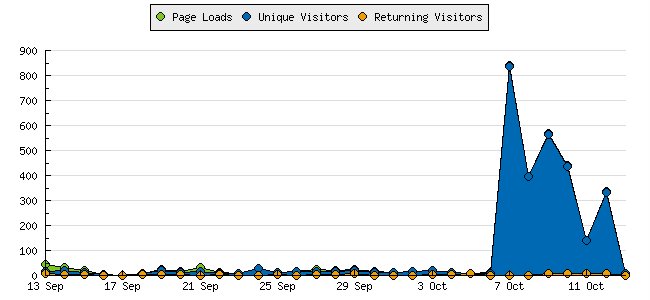 I have no idea how nor why it happened, but suddenly the Impactroom blog started receiving serious numbers of visitors. From an average of 30 visitors a day readership exploded to nearly 900 visitors last Saturday. The graph shows a decline after the initial peak, but still, some 3000 visitors in 1 week, that's quite spectacular for a blog this size. All the visitors are coming from the US, that makes it more mysterious. On top of that the visitors come from all over the US, the readership is not concentrated at all. If anyone has an idea what could have happened, don't hesitate to contact me. Thank you all for the tremendous support and interest.
Thursday, October 12, 2006
Albrecht's Law: Examples of Successful Organizational Intelligence and Collective Stupidity (5)
An example of an organization that suffered from 'collective stupidity':
Karl Albrecht: "One of the most legendary episodes of collective stupidity was with Ford Motor Company in Detroit. In the early 1980s, they launched a new advertising program with the slogan "No unhappy owners." The TV ads promised that every Ford owner would have a car he or she was happy with, and if there was anything wrong, the company would make it right. The only problem was that they neglected to tell several thousand dealers about the ads. The dealers were swamped with unhappy owners, who became more unhappy when the dealers couldn't handle the volume of traffic.
This is the quintessential case of what I call "ballistic podiatry," otherwise known as shooting one's self in the foot."
An example of an organization that successfully utilized Organizational Intelligence:
Karl Albrecht: "On the opposite side, one of the legendary examples of collective intelligence, which has been going on for many years, is the remarkable orchestration of the daily experience of magic in the Disney theme parks. From the recruitment, indoctrination, training, placement, and supervision of the employees, all the way to the design and maintenance of the facilities, the delivery of customer value expresses the Disney business model, which is "fun and fantasy in a theatrical setting." Disney designers and managers are some of the world's best experts at eliminating the contradictions to the core proposition of value."
Wednesday, October 11, 2006
Albrecht on Imagination (4)
What importance does human imagination play in the overall success of an organisation?
Karl Albrecht: In all of the developed economies, organisations are shifting from "thing-work" to "think-work." This applies to government and the non-profit sector as well as the corporate sector. In the knowledge economy, fewer and fewer people make their living by making things, and more of them make their living by working with data, information, and knowledge. This means that practical thinking skills - including imagination, but certainly not limited to that - will be ever more in demand.
HR experts predict an increasingly severe "smart gap," meaning that we'll have a tougher time finding employees who can think beyond their noses. Inasmuch as the public education systems are failing miserably to provide us with the smart people we need, we will find it necessary to grow our own smart people. I believe more and more organisations will take up the role of educator of last resort, and invest more heavily in the mental competence of their workers.
At a time when companies are spending tens of millions of dollars on information technology - the machine software - they've so far not seen fit to spend a few tens of thousands of dollars on improving the mental skills of their employees - the human software. As we begin to realize how much of the IT investment is being wasted or misdirected, I believe we'll be spending less on the machine software and more on the human software.
Subscribe to:
Posts (Atom)

 Posts