Wednesday, May 03, 2006

The 3 marketing D’s: Design – Deliver - Develop

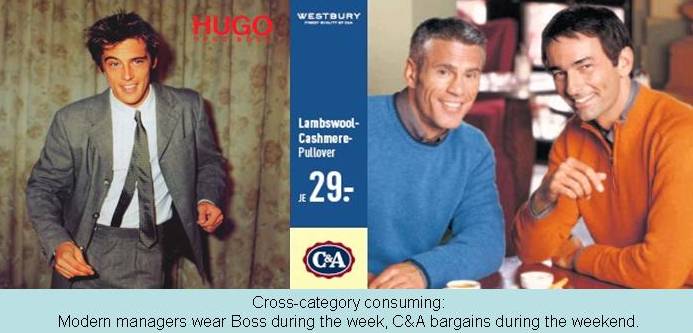
Standard marketing tools were the result of processes and practices developed in traditional consumer goods companies in the 50’s and 60’s. Their marketing departments invested in research looking for demographic, sociographic even psychographic profiles of their customers followed by bombarding the potential clients through traditional advertising media. The involvement of the traditional marketing department stopped once the product was sold. This is no longer valid. Consumers are not looking for “products” anymore, they are looking for a “customer experience”. They don’t hook their soul anymore to one “product category”, they have become extremely “cross-category”. For example: On Sunday the customer will go to his exclusive traditional bakery for bread and pastry. On Wednesday he goes to Aldi for sandwiches and hotdogs for a birthday party of the children. Or business people in Hugo Boss during the week are wearing C&A bargains in the weekend.

Consumers have gone the other way than their traditional suppliers. When Bain & Company surveyed 362 firms it found that 80 % believed they delivered a “superior consumer experience”. However when the customers were asked to rate the same suppliers only 8% of the suppliers seemed to deliver a superior experience. To close this gap suppliers should concentrate on developing the following three marketing D’s.

- Design an entire customer experience instead of just developing a product and pushing it into a market.
- Deliver the propositions of a customer experience at the lowest cost possible involving a cross departmental action plan.
- Develop a relationship with the client so you can follow up on the ever increasing shifts in customer attitude, to be able to deliver again, again and again.

Monday, May 01, 2006

John Kenneth Galbraight just died

Economist of importance. Became famous with his bestsellers "The Great Crash" (1929) and especially "The Affluent Society" (1958). One of the arguments in The Affluent Story was that the United States had become rich in consumer goods but poor in social services. Galbraight had the gift to explain complex economical theories in a simple language understandable for 'the men in the street'. He became professor at Harvard University. He often described himself as an "evangelical Keynesian" (Keynes advocated government spending to reduce unemployment) . Galbraight supported a much shorter work week, the women's liberation movement and the creation of an international council to help the victims of man-made disasters.
Some quotes:
(commenting on the Dow Jones Industrial Average's breaking the 6,500 mark he said:) "There is too much money chasing too little intelligence to manage it. It can't last."
(In an interview with the BBC:)
"There are some advantages of being right. You don't have to change your mind."

He died last Saturday 20-04-2006 at a hospital in Cambridge, Massachusetts. He was 97.
(www.johnkennethgalbraight.com)

Sunday, April 30, 2006

Master Sun said:

Managing many
Is the same as
Managing few;
It is a question of
Division.

Figthing with many
Is the same as
Fighting with few;
It is a matter of
Marshalling men
With gongs,
Identifying them
With flags.

The Skilful Warrior attacks
So that the enemy
Cannot defend;
He defends
So that the enemy
Cannot attack.

Weakness
Stems from
Preparing against attack.
Strength
Stems from
Obliging the enemy
To prepare against an attack.

He who advances
Without seeking
Fame,
Who retreats
Without escaping
Blame,
He whose one aim is
To protect his people
And serve his lord,
This man is
A Jewel of the Realm.

Never move
Except for gain;
Never deploy
Except for victory;
Never fight
Except in a crisis.

(Sun Tzu - The Art of War - Strike with Chaos)

Thursday, April 27, 2006

View on Wall Street Journal Operations

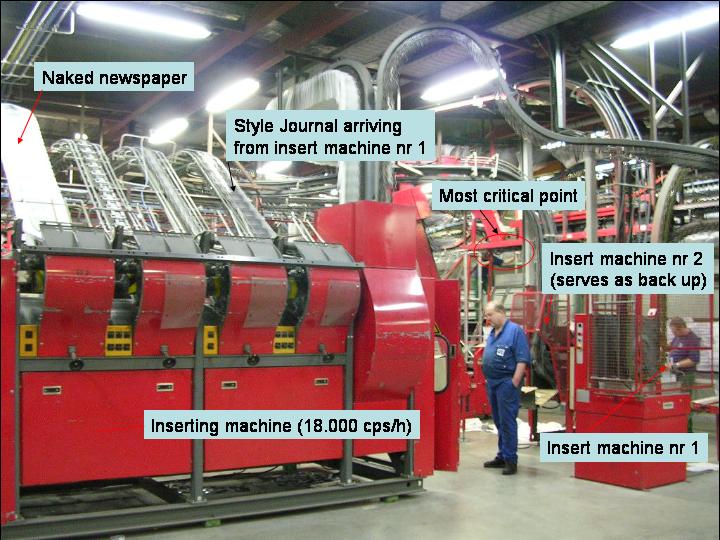
A major project for the Wall Street Journal Europe. Tonight we will insert a brand new magazine "Style Journal" (featuring Ralph Fiennes on the cover) in the Wall Street Journal Europe circulation. For months the Distribution Operations team is preparing the insert of this glossy 190 grams magazine in a 56 page newspaper in 9 printplants destined to go to 75 countries. All teammembers are spread over Europe to follow up in the respective mailrooms. Surprisingly we noticed that laborers, the people that actually do the work in the printplants at night (packing, polywrapping, cutting, folding, glueing, inserting, counting,...) took the initiative in 3 printplants to organize testruns without being ordered to do so by their uppermanagement or by us, the client. In Brussels for example they tested three nights in a row to adjust their machines after the normal production of their newspapers. Something quite out of the ordinary in a very unionized environment especially because there was no order from "upperhand" to do so. It is an interesting exercise to try to find out what drives laborers to take initiative, to excel, to step outside their normal routine. It is as if there is a virtual nightly competition between the laborers of our printplants in Europe (impossible in reality because we work with independent printplants, there is surely no contact whatsoever between the employees of the resp plants).

Wednesday, April 26, 2006

Are managers becoming disposable leaders ?

It's a thought, it is a feeling, but organizations-an-sich, especially clusters of collaborators seem to become more time-dependent, limited in time, often just temporary mini structures that cease to exist after a specific task has been done. This also has an impact on the role and life cycle of managers within a company. Managers are experiencing nowadays what football (soccer) trainers already experience for years. They all have a short lifespan in a company or club. They are replaceable assets. They come and go together with new 'momentums'. No reason for leaders and managers to create or even follow a longterm vision, .... ?
Feel free to comment.

Tuesday, April 25, 2006

"Yes, management and leaderschip are both critically important"

Yes, management and leaderschip are both critically important in the ongoing success of an organization, but no, they are not interchangeable. On the contrary, the role of the leader and the role of the manager are utterly different. The responsibilities are different. The starting points are different. The talents required to excel at each are different (...) This doesn't mean that you cannot excel at both. You can. But it does mean that, if you want to choose between one or the other as your primary focus, you need to be aware of the difference (Buckingham, 2005)

Friday, April 21, 2006

Management Quotes

For those interested in Management Quotes, go to: http://www.managementquotes.blogspot.com

Do not hesitate to send me quotes that make life of managers more understandable.

Thursday, April 20, 2006

Management Mugs

NEW! Subtle mugs for subtle managers.
Message on the mug: "There is a leader in every manager. There is not a manager in every leader."
(order them by e-mail, see profile: 18 Euro + postal cost)

Wednesday, April 19, 2006

Tuesday, April 18, 2006

Management Theories ??

What people thought about 'management' was subject to great changes and paradigm shifts over the past century. Basically there are three 'periods' that produced typical management theories.

1. Period of the Scientific Management Theory (1890-1940)
Around 1900 organizations became 'industrialized'. The manufacturing process was based on ongoing routine tasks. Management in the factories started to measure and specify their activities and results. In this atmosphere a Frederick Taylor developed his "scientific management theory". His 5 principles of management were:
- Develop a science for each element of an individual's work.
- Scientifically select, train and develop the worker.
- Heartily cooperate with the workers.
- Divide work & responsibility equally between managers & workers.
- Improve production efficiency through work studies, tools, economic incentives.
Frederick W. Taylor, The Principles of Scientific Management (New York: Harper Bros., 1911)


2. Period of the Bureaucratic Management Theory (1930-1950)
Most well known advocate of this theory was a Max Weber. Weber made a breakdown of organizations in hierarchies, focusing on strong lines of authority and control. He advised the industry to start standardizing the operational procedures for at least all routinezed tasks.

3. Period of the Human Relations Focused Theory (1930-today)
Former theories lacked the 'human' element. One could say that the worker was compared with and measured against machines in the past. The paradigm shifted from dehumanazing industrial linework to individuals who seemed to be able to make a difference in the results of the company. The first Human Resources departments were introduced to tap into this unknown pool of capacities and opportunities. Revolutionary was the idea that the organization would prosper if the workers were actually 'happy' and prospered as well.

(Various new theories came to existence later on, most of them based on the behavioral sciences.)

Friday, April 14, 2006

If your upcoming business careers were a movie plot, it would resemble the movie "Speed."

“Speed Saves: Living on the Edge is America’s Edge”

6 thoughts from a speech of Mitchell E. Daniels (a US Governor) in a Lecture for the Rose-Hulman Institute of Technology. Read the complete and sometimes hilarious (certainly from a European viewpoint) speech at: www.managementspeeches.blogspot.com.

1. While the European Union busies itself writing layer upon layer of rules, Americans are starting 600,000 new businesses every year.
2. It seems an American can conceive, finance, launch a business, and fail or succeed in less time than it takes a European to get a license to operate.
3. Americans fix problems as they arise; Europeans often seem bent on preventing any chance of trouble arising in the first place.
4. At Mothers Work, a maker of maternity apparel, the motto is "Give the lady what she wants when she wants it."
5. Thomas Edison ran 2000 unsuccessful experiments before his filament produced sustained illumination. When a reporter asked him how he dealt with all that failure, Edison said "I never failed. I invented the light bulb in a 2000-step process."
6. America loves winners, but we love losers even more, when they get back on the track and into the race.

Wednesday, April 12, 2006

Management Speeches

For the ones interested in good management speeches I created www.managementspeeches.blogspot.com

First speech is an interesting speech from Kurt Kuehn Senior Vice President, Worldwide Sales and Marketing, UPS. He started as a delivery driver for UPS in 1977 and worked his way up.

He highlights five areas that are critical to business plan objectives, and he shows how synchronized commerce can help drive real results, by attacking the “soft three dollars.”
The five strategic imperatives are not limited to the retail industry. These are universal challenges:

- improving financial metrics;
- driving growth through new geographies, new channels, and new business conditions;
- differentiating yourselves in a world of increased parity;
- enhancing customer service;
- increasing productivity

More on www.managementspeeches.blogspot.com

Kurt Kuehn Senior Vice President, Worldwide Sales and Marketing, UPS

Tuesday, April 11, 2006

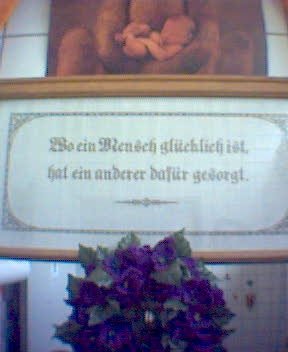
Management lessons from a diaper room.

"So ein Mensch gluchlich ist, hat ein anderer dafur gesorgt."


Happiness is to be found in small places. In Germany for example, in a baby diaper room, a tiny space in the restrooms of a JET gasoline station along the highway from Koln to Belgium. A toilet lady turned 'her' diaper room in a cozy, baby friendly environment with some curtains, dolls, pictures on the wall, flowers, oils, and all sorts of tissues with nice scents. Centrally she hung a German proverb saying: "When someone is happy, somebody else made him that way." A management lesson never to forget. On top of that, the toilet lady turned out to be a master marketeer subtly selling herself. Although you were not obliged to pay some money leaving the restroom, I never saw bigger tips coming her way from the mothers using this diaper room.

Tuesday, April 04, 2006

Managers still create the wrong companies.

In 1970 3 Dutch people wrote a revolutionary little book "The Little Red Book for Students" *. It was published by A.W. Bruna & Son. The cover was created by Dick Bruna the famous inventor of 'Miffy' ('Nijntje' in Dutch).

The book was handed out to thousands of students in Europe. It basically criticizes the then existing 'schoolsystem', 'society' and 'ethics'.

In 1970 this was what they wrote on 'Authority on the job':
" ... If you pass your examinations at school successfully, you will go to work. You will end up at a work floor or behind a desk. You will do what is expected from you, because you are expected to do so. That is what you are paid for. Others will determine the value of your work. You will receive orders from 'above'. If you perform well you will receive subordinates. You are important as long as you are profitable. If you raise your voice or question the company you will be removed or you will be fired. The strategy is in hands of uppermanagement. If the strategy fails the company will be closed. That is the reality today.
......... BUT it can be different. A truly democratic company is owned by the people who really do the job. They decide what has to be done. They will assign or remove the director or the uppermanagement. They will decide where the profit goes to. They are able to decide on every company aspect because all relevant info comes to them or through them. There is no difference between people who 'think' or people who 'do'. Every employee is responsible for every product the company produces. The company does not exist to help the shareholders or the powerful elite behind the company, to make more money. The company exists only to do and to produce what the employees need. What they need is what they decide upon amongst themselves. ..."

We are now 35 years later. Did the students that received this Little Red Book in their teens change the world ? I doubt it.
Besides that I must admit that the Little Red Book is from a genuine optimism and it breaths REVOLUTION. More then 125.000 books were produced from September to December 1970. I found it by accident by cleaning house for my mother in law, a former progressive teacher. If you want a copy of this jewel from the past send me an e-mail.

*A lot of the content was based on a 1969 Danish book "Den lille rode bog for skoleeleever" from 3 Danish writers (published by Hans Reizels Forlag, Copenhagen)

Friday, March 31, 2006

Mama, the water talks to me !

The Importance of Visualization.
Soon we will have colored water leaving our taps. It may sound weird or even farfetched. But only at first sight. In reality this is an earthquake in our bathrooms.
We, humans, already deserved to have colored water for more than 2000 years. Only now we have the technology to actually let the water talk to us and indicate whether it is cold (blue), warm (rose) or hot (red). Imagine the importance for our children!

The color of the water is an answer to a question everyone poses himself in the nanosecond before he reaches out to wash his hands. It is a question we ask ourselves without even realizing it anymore. But our primitive system does raise the question. It wants to protect us from burning our hands. Hot or cold? That is what we need more, products that really talk to us.

(Pictures, the design taps from the German company Hansa. Today for the Happy Few, tomorrow for everybody)

Thursday, March 30, 2006

When it can't be done. Do it. If you don't do it, it doesn't exist.

"A NEW idea can be either unfamiliar, or silly, or both.
It can't be judged by description. It needs to be done (made) to exist.
It is unlikely that anyone will sanction the cost of something they don't understand, therefore you have no choice but to do it yourself.
At whatever cost.
You may have to BEG, STEAL and BORROW to get it done. But that's for you to work out how you do it.
It's exciting.
It's difficult and it's fun.
If it was easy anyone could do it."

(Paul Arden, Executive Creative Director Saatchi and Saatchi for 15 years. In his book: "It's not how good you are, it's how good you want to be")

Friday, March 17, 2006

Speeddating for Managers

How to organize a meeting between 600 people ?

-Paris this week-
When I started to attend the 'Journees de la Presse' in France a few years ago I was confronted with a simple but efficient system to bring 600 people together in 1 day.

- The organizer (NMPP) rents a conference room in a 5 star hotel.
- The organizer divides his contacts up in two groups: 'receivers' and 'guests'.
- The conference room will be filled with tables for 4 people.
- The tables are nicely positioned in 'rows' and 'columns'.
- All 'rows' receive (a bit as in chess) a number. All 'columns' receive a letter.
- Numbers and letters are put on big signs along the conference room.
- 'Receivers' are invited to take place at the tables for a day.
- 'Guests' are invited to walk around and 'visit' the receivers following a tight schedule of 30 minute meetings.

The only thing 'guests' and 'receivers' have to do is organize their meetings before the actual meeting day. This sometimes involves intricate puzzling by the secretaries of all managers present.

An interesting side effect of this kind of very structured event are the unofficial meetings that tend to grow outside the official conference room. This kind of event can also be a moneymaker for the organizer. It is not unusual for the organizer to actually 'rent' his tables to the 'receivers' and asks income from the 'guests'.

Left: This sign gives an overview of all the 'recievers' and their code to indicate their position in the conference room. The sign is posted at the entrance of the conference room + it is printed in the conference catalogue.

Wednesday, March 01, 2006

5 cynical tips to become a successful entrepreneur


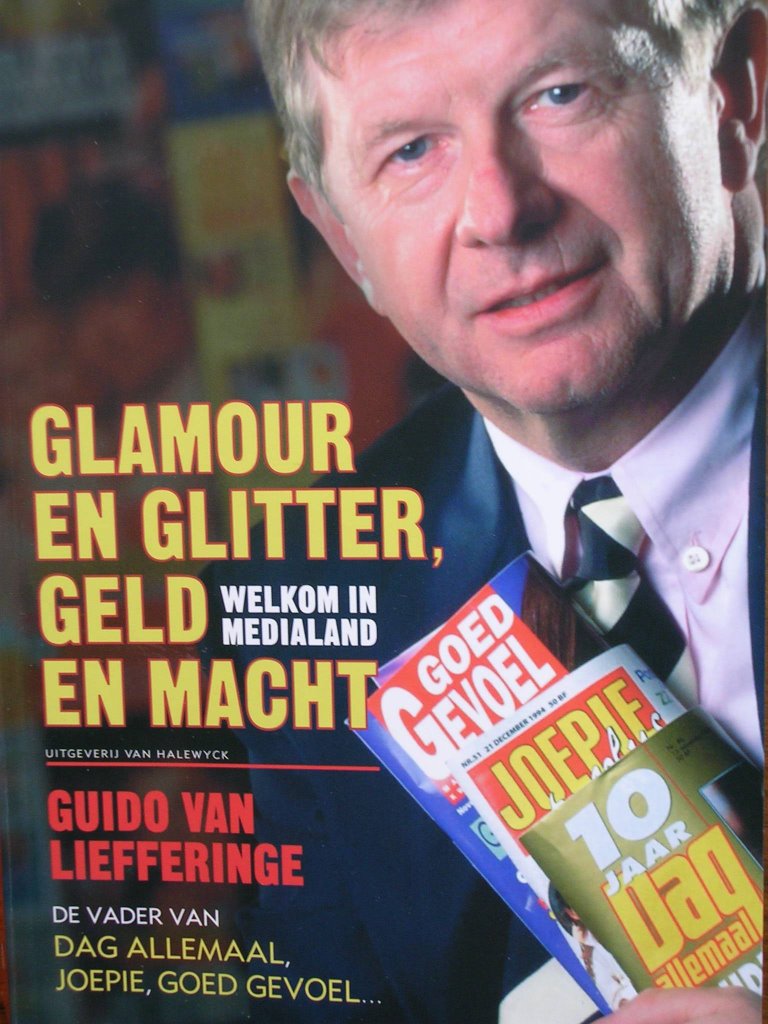
The biography of a fairly unknown man, Mr Van Liefferinge (see picture left), came out recently. Although unknown the man invented all best selling magazines in Belgium during the last 20 years. He also became extremely rich in the process doing so. Guido Van Liefferinge has 'print' running through his veins. Moreover he was a media-mastermind looking after the democratic values of a free, but popular press.

Unfortunately to be able to launch all these successful magazines he had to cooperate with one of Belgians largest publishing houses, De Persgroep. His longtime relationship with this media powerhouse ended beginning 2000 in a disgraceful fight. De Persgroep allegedly removed him wrongful from his position cutting the ties between him, the inventor (or father) and all his magazines (his children, as he writes). He is now fighting a fierce legal battle with his former partner.

The book is more then an account of how he invented the magazines, it is a complaint against the management of De Persgroep. It is a bitter book by a bitter man, although he claims not to be.
He gives the following (cynical) advice to become a successful entrepreneur today:
1. Your primary goal is 'networking'. Alumni of managementschools, high level consultants, members of the establishment, all people who meet each other for the wrong reasons, are goldmines for your career.
2. Lobby. You can not stop sucking up government and her representatives to obtain government funds, subsidies, licenses etc, 'goodies' a normal entrepreneur does not need to build his business in the normal way in a normal deregularised market.
3. Divide et Impera. After having had confidential conversations, go with the info to third parties or change the content and spread around.
4. Keep secret agenda's. Just lie about the real goals of your actions. Remember that these days 'perception is reality'. Act as if your are building a transparent house, but build it on perceptions.
5. Start with 'perception -management'. Tell the world you are the best, do it over and over again, till everybody believes it. Use and misuse your contacts in the media. Lie about the competition or lie about people in your company you don't like anymore.
As said, the above 5 rules are not meant to be followed by 'good' people. They merely explain why 'bad' people become successful entrepreneurs.

Before I knew who he was he called me one day in 1995. He wanted to speak to me about a magazine I was publishing. Since I didn't know him, and since he had called me, I kind of said that if he wanted to speak to me he should come to my office some 70 km from where he had his office. It was as if the caretaker ordered the king to come down to the basement, I realized myself years later. He abruptly said "I think you should come to me, it will be worthwhile". "But I had a car accident," I replied, "I am wearing a collar and I don't have a car anymore." He replied "I still think you should come to me, take a taxi (70 x 2 = 140km!!!!), it will be the best investment you ever made". I went to see him, evidently. Nothing came from it :-) apart from the fact that I learned more about magazine publishing in the 1 hour I was with him, than all the years at school and university.