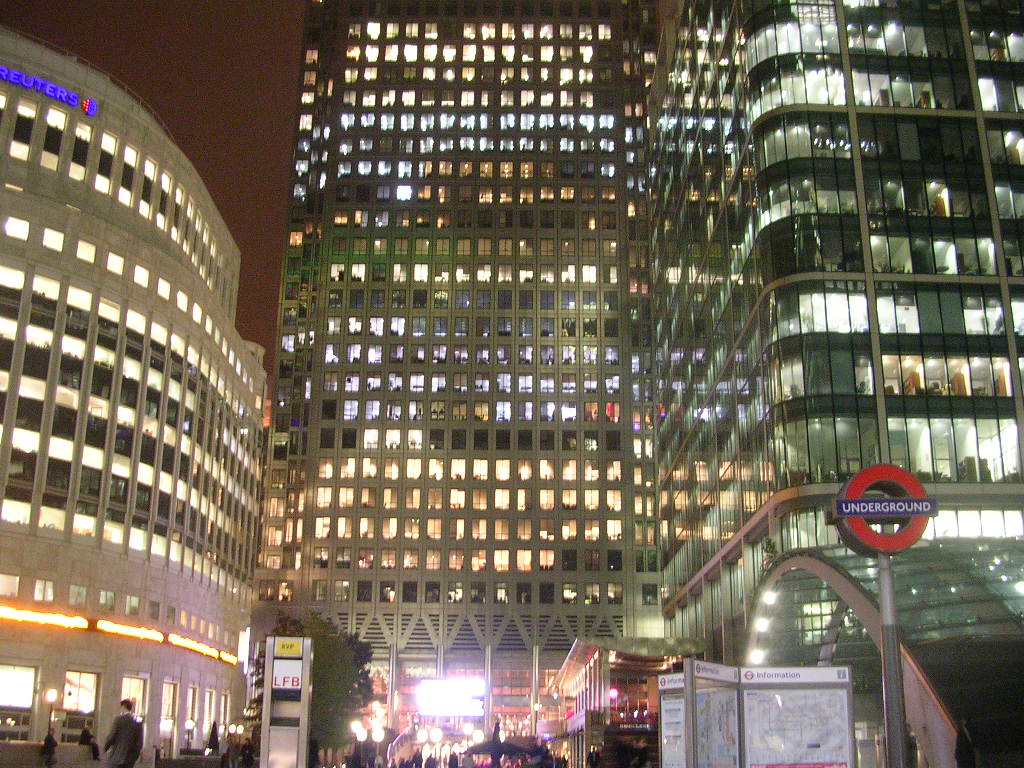
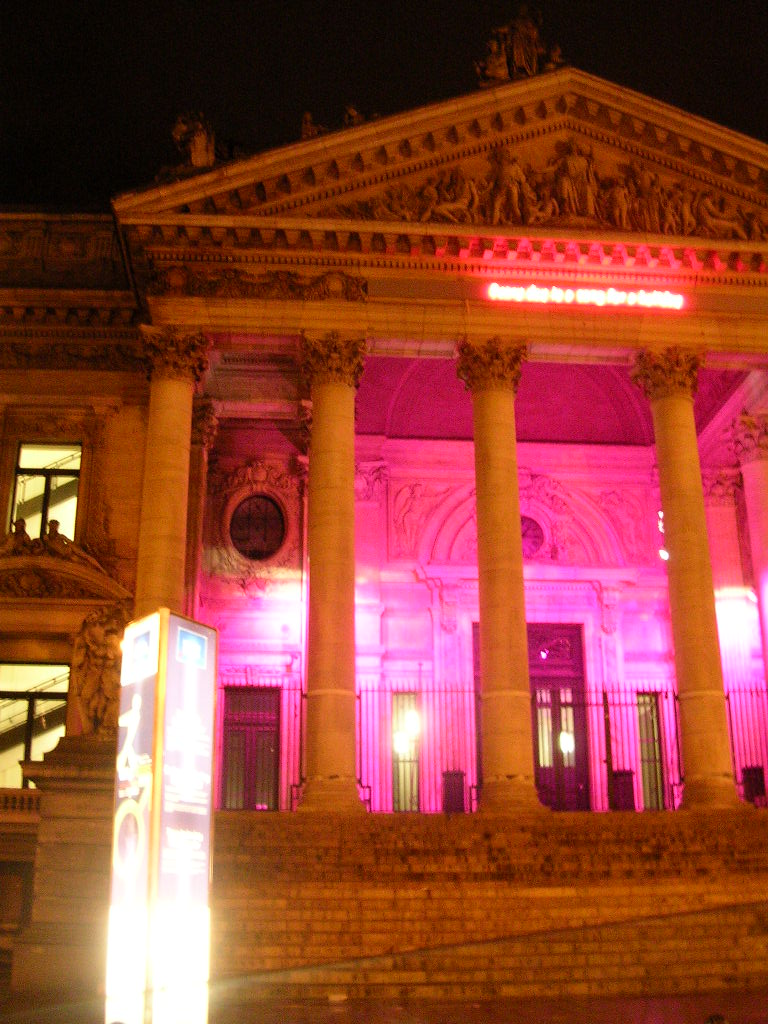
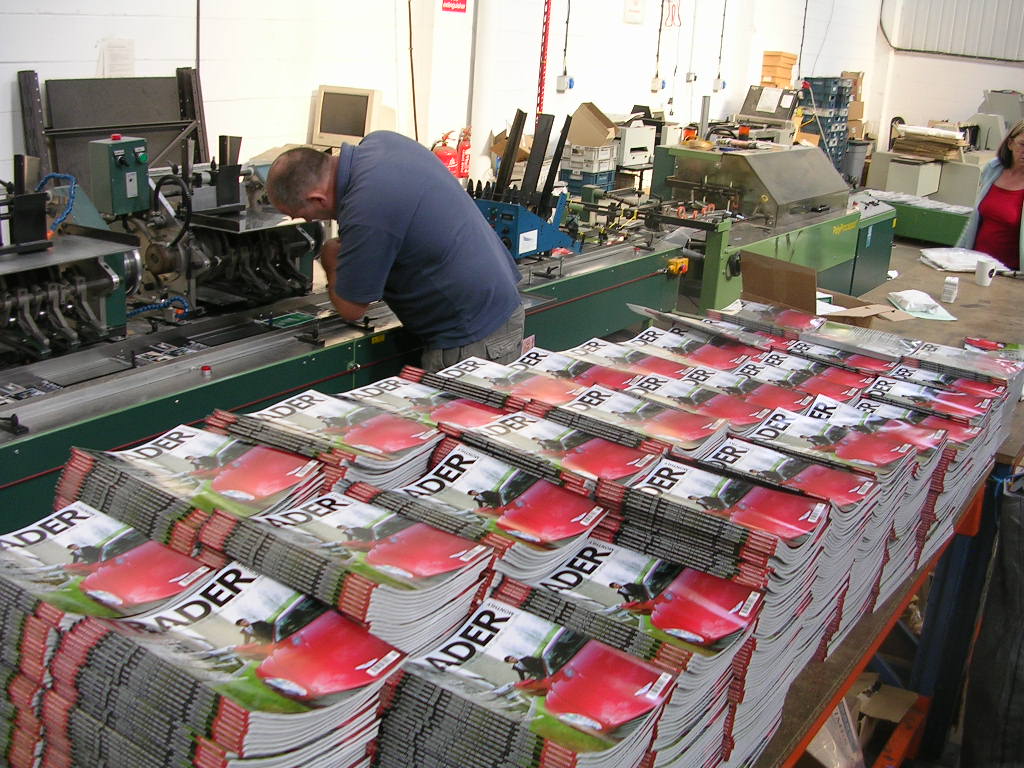
in order not to disturb normal traffic during daytime at street level.
Friday, February 16, 2007
Following up on Trader Magazine Ops in London on Valentine's day.
in order not to disturb normal traffic during daytime at street level.
Monday, February 12, 2007
Harvard University elects first female president.
Drew Gilpin Faust, a historian of 59, was named the university's 28th president. She is the first woman president in Harvard's 371 year history. Faust is the first Harvard president who did not graduate at the university itself since 1672. (Charles Chauncy, a former Cambridge alumnus from England died in office at Harvard that year). Faust attended Bryn Mawr College and the University of Pennsylvania, where she was also a professor of history. Born Catherine Gilpin in a privileged family in Virginia, Faust was dean of Radcliffe since 2001, a think-tank with 87 employees and a $17 million budget. The Radcliffe women’s college was merged into Harvard University in 1999, as a research center with a mission to study gender issues. Faust will preside now over Harvard's 11 schools and colleges, 24.000 employees and a budget of $3 billion. The Harvard presidency is considered by many the most prestigious job in higher education worldwide. Harvard is the oldest university in the US.Thursday, February 08, 2007
Management Jobs - Collaboration with Jobat.
Friday, February 02, 2007
Thank You! 25.000th visitor to the Impactroom blog.
Thursday, February 01, 2007
BAM! The new ad campaign for The Wall Street Journal - so good it feels like it was made in Europe
I know it is not 'cool' these days to admit you actually admire the multinational you're working for for something that was decided and executed at the other side of the world. But I can't help myself in this case. The way the Journal is portrayed is very appealing.
Gordon Crovitz, one of the executive VP's of DowJones, said the following about the campaign:
"The tagline for this campaign is "Every journey needs a Journal." The advertisements feature a diverse group of successful men and women, all icons leading their fields. Each includes a "life journal" that incorporates a Journal article to show how the Journal makes a difference in the lives of readers.
This campaign promotes the Journal however, whenever and wherever people want it-in print, online, mobile and other channels. .....
Some of the featured readers are CEOs inspired by what they read. JetBlue founder David Neeleman, for example, recalled as a college student in 1979 reading a page-one Journal article on airline deregulation. "When I read this article, I started thinking, how would this change air travel and could we create something that could really appeal to the masses as opposed to the elite few?"
Singer-songwriter and producer Sheryl Crow says the Journal has long been part of her life. "My grandmother was a newspaper editor, which was very unusual for women at that time, and she was very, very strict about what she read," Ms. Crow told us. "The Journal was always around our house. For me, growing up, that was the serious newspaper. Now, watching how reporting has taken a turn toward the tabloid, I appreciate the Journal because it is fair journalism you can count on." She chose to highlight a Journal article on breast cancer.
Other featured readers include Tiki Barber, former New York Giants running back; Jake Burton, founder and chairman of Burton Snowboards; Kenneth Cole of Kenneth Cole Productions, Inc.; Oscar De La Hoya, Olympic Gold Medal boxer and head of Golden Boy Promotions; Steven Levitt, University of Chicago professor and co-author of "Freakonomics;" Maya Lin, architect and designer of the Vietnam Veterans Memorial in Washington, D.C.; Paul Teutel Sr. of the reality TV series "American Chopper;" and Alice Waters, founder of Chez Panisse restaurant and healthy foods advocate.
These featured readers did not seek payment for their endorsements. Instead, the Journal is contributing advertising space to their favorite charities. Giving back is part of the journey of success for Journal readers.
Brand experts say the Journal is very unusual, perhaps unique, in what marketers call its "brand equities". Journal readers and non-readers alike give the Journal very high marks for integrity, authority accuracy and fairness. The Journal's reputation in these areas is, of course, our most important asset, earned by the work of generations of Journal reporters, writers and editors.
Our challenge, however, is that non-readers who have educational levels, careers and incomes that suggest they would benefit from reading the Journal differ from our readers in one key respect: Too often, they say the Journal "isn't for people like me." It's this perception among non-readers we'd most like to correct.
The campaigns web site at http://www.journey.wsj.com/ includes all the print and online advertisements. It includes video interviews with the featured celebrities explaining their ties to the Journal. There are also interactive features, including the ability for readers to post their own life's journeys and the role the Journal plays. "
Wednesday, January 31, 2007
Mission Statement - Microsoft
Our Mission
At Microsoft, our mission and values are to help people and businesses throughout the world realize their full potential.
Our Values
As a company, and as individuals, we value integrity, honesty, openness, personal excellence, constructive self-criticism, continual self-improvement, and mutual respect. We are committed to our customers and partners and have a passion for technology. We take on big challenges, and pride ourselves on seeing them through. We hold ourselves accountable to our customers, shareholders, partners, and employees by honoring our commitments, providing results, and striving for the highest quality.
Corporate Citizenship
Every successful corporation has a responsibility to use its resources and influence to make a positive impact on the world and its people. MicrosoftÂs Global Citizenship Initiative is focused on mobilizing our resources across the company and around the world, to create opportunities in the communities where we do business, and to fulfill our commitment to serving the public good through innovative technologies and partnerships.
http://www.microsoft.com
Monday, January 29, 2007
Mission Statement - General Electric
Values - Imagine, solve, build and lead - four bold verbs that express what it is to be part of GE. Their action-oriented nature says something about who we are - and should serve to energize ourselves and our teams around leading change and driving performance.
For more than 125 years, GE has been admired for its performance and imaginative spirit. The businesses that we invent and build fuel the global economy and improve people's lives. Today, we are 11 technology, services and financial businesses with more than 300,000 employees in 160 countries around the world.
What unifies us? Our Actions and Values.
What we do and how we work is distinctly GE. It's a way of thinking and working that has grounded our performance for decades. It's a way of talking about our work and ourselves that takes the best from our past and expresses it in the spirit and language of GE today.
It's about who we are, what we believe, where we're headed, how we'll get there. It's how we imagine, solve, build and lead.
Imagine.
From the very beginnings of our company, when Thomas Edison was changing the world with the power of ideas, GE has always stood for one capability above all others - the ability to imagine. Imagine is a sense of possibility that allows for a freedom beyond mere invention. Imagine dares to be something greater. At GE, Imagine is an invitation to dream and do things that you didn't know you could do. Because at GE the act of imagining is fused with empowerment - the confidence that what we imagine, we can make happen.
Solve.
Every business has to have a reason to exist - a reason that answers the fundamental question of "why are we here?". For GE, the big question has a simple answer: We exist to solve problems - for our customers, our communities and societies, and for ourselves.
Build.
From 0 to 60 in six seconds? Try zero to $5 billion in five years. It's not so much a vision for our future - where we're headed is in many ways a reflection of where we've already been. It's not a destination. It's a quest. A quest for growth. And when we look to the future, we know that for us, there's only one way to get there. Build. Lead. Imagine. Solve. Build. Each of these is merely a word without one vital element:
Lead.
GE is already synonymous with leadership. But with this mantle comes responsibility. And it's not just a responsibility to maintain the status quo or manage what worked yesterday. It's the bigger responsibility to change. Because change is the essence of what it means to lead. It's a call to action that engages our unceasing curiosity, our passion, and our drive to be first in everything that we do.
We Are a Company to Believe In.
Imagine. Build. Solve. Lead.
In the end, our success is measured not only by our ability to think big, dazzling thoughts, but by our commitment to sweat the small stuff that brings ideas to life. It's a way - thinking and doing - that has been at the heart of GE for years.
The worth of this framework is how we translate it into our own personal work ethic and then extend it to our teams, businesses, cultures and different regions of the world. It's permission to cast aside any approach that seems dated - to imagine, solve, build and lead a better way of doing things.
Values
While GE has always performed with integrity and values, each business generation expresses those values according to the circumstances of the times. Now more than ever the expression and adherence to values is vital. More than just a set of words, these values embody the spirit of GE at its best. They reflect the energy and spirit of a company that has the solid foundation to lead change as business evolves. And they articulate a code of behavior that guides us through that change with integrity. The words reflected here represent a revitalization of our values. They are a call to action that asks every GE employee to recommit to a common set of beliefs about how we work in our world today. And while some of these words are new in their expression, they are based on a continuum of how GE has grown and performed through generations. They are our words and our values... in our own voice.
- Passionate
- Curious
- Resourceful
- Accountable
- Teamwork
- Committed
- Open
- Energizing
- Always With Unyielding Integrity
The GE Values Card
Friday, January 26, 2007
Mission Statement - International Herald Tribune - with a sense of humor...
A very interesting mission statement is the one of the International Herald Tribune (IHT). Especially the last one of their Rules of the Road seems to energize some IHT employees.
Our Core Purpose
Enhance society by creating, collecting and distributing high quality news, information and entertainment.
Our Core Values
- Content of the highest quality and integrity--This is the basis for our reputation and the means by which we fulfill the public trust and our customers' expectations.
- Fair treatment of employees based on respect, accountability and standards of excellence.
- Creating long-term shareholder value through investment and constancy of purpose.
- Good corporate citizenship.
Rules of the Road
Success at The New York Times Company means more than achieving our financial and journalistic goals. Our Company believes that all employees should conduct themselves in a manner consistent with our tenets of behavior, our Rules of the Road:
- Be stewards of our Company's brand reputation and assets.
- Treat each other with honesty, respect and civility.
- Uphold the highest journalistic, business and personal ethics.
- Keep a relentless focus on serving our customers.
- Innovate to reach our full competitive potential.
- Execute with urgency, agility and excellence.
- Champion diversity.
- Collaborate to harness our collective strengths.
- Achieve results by challenging yourself and mentoring others.
- Maintain perspective and a sense of humor.
Thursday, January 25, 2007
Six Guiding Principles Starbucks Coffee Company
The Starbucks mission statement for example says:
The following six guiding principles will help us measure the appropriateness of our decisions:
- Provide a great work environment and treat each other with respect and dignity.
- Embrace diversity as an essential component in the way we do business.
- Apply the highest standards of excellence to the purchasing, roasting and fresh delivery of our coffee.
- Develop enthusiastically satisfied customers all of the time.
- Contribute positively to our communities and our environment.
- Recognize that profitability is essential to our future success.
Tuesday, January 23, 2007
The 7 Winning DowJones Principles
2. Commit to the Virtuous Circle - excellent journalism, business and people are mutually reinforcing drivers of success
3. Live our Values - quality, integrity and independence, everywhere and always
4. Build Value - for our customers, shareholders and employees
5. Constantly Innovate - content, products, technology and business processes; purposeful change and smart risk-taking
6. Build Top Talent - attract, develop, motivate and retain the best, diverse talent; insist on teamwork; abhor silos
7. Get Results, Now - commit to action and results
Wednesday, January 17, 2007
Barracuda Management
Monday, January 15, 2007
Humor Between Different Levels of Employees.
After every flight, Qantas pilots fill out a form, called a "gripe sheet," which tells mechanics about problems with the aircraft. The mechanics correct the problems, document their repairs on the form, and then pilots review the gripe sheets before the next flight.
Never let it be said that ground crews lack a sense of humor :-)
Here are some actual maintenance complaints submitted by Qantas' pilots (marked with a P) and the solutions recorded (marked with an S) by maintenance engineers.
By the way, Qantas is the only major airline that has never, ever, had an accident.
P: Left inside main tire almost needs replacement.
S: Almost replaced left inside main tire.
P: Test flight OK, except auto-land very rough.
S: Auto-land not installed on this aircraft.
P: Something loose in cockpit.
S: Something tightened in cockpit.
P: Dead bugs on windshield.
S: Live bugs on back-order.
P: Autopilot in altitude-hold mode produces a 200 feet per minute descent.
S: Cannot reproduce problem on ground.
P: Evidence of leak on right main landing gear.
S: Evidence removed.
P: DME volume unbelievably loud.
S: DME volume set to more believable level.
P: Friction locks cause throttle levers to stick.
S: That's what friction locks are for.
P: IFF inoperative in OFF mode.
S: IFF always inoperative in OFF mode.
P: Suspected crack in windshield.
S: Suspect you're right.
P: Number 3 engine missing.
S: Engine found on right wing after brief search.
P: Aircraft handles funny.
S: Aircraft warned to straighten up, fly right, and be serious.
P: Target radar hums.
S: Reprogrammed target radar with lyrics.
P: Mouse in cockpit.
S: Cat installed.
P: Noise coming from under instrument panel. Sounds like a midget pounding on something with a hammer.
S: Took hammer away from midget.
About humour in professional situations:
Kahn argues (1989:46): "Each statement contains its own truths. If we attend to these statements, and piece together their various truths from clues within the contexts of their expression, we can tap into a rich source of information for understanding the dynamics of individual and group life in organisations."
Friday, January 12, 2007
Take Care, Take Care, Take Care
Now he and his family are facing the transition to a completely different culture. His two kids (6 and 5) re-entered school this week. Not their little Flemish local community school, but an American International School in South Africa, with...guards, fences, English, 50 nationalities, and a daily morning ceremony including the 'code'. During this ceremony all childeren will recite a short code of just 3 lines, after which anybody with an issue, can address the community publicly. This way enabling the children to learn to speak in public. There is a lesson here.
The 'code':
Take care of yourself.
Take care of the others.
Take care of this place.
American International School in South Africa
Morning Ceremony including the 'Code'
The 10 UN Global Compact Principles
The Global Compact is an international initiative by United Nations Secretary-General Kofi Annan, bringing together businesses and UN agencies, the labour world and the civil society around 10 principles related to human rights, labour standards, the environment and anti-corruption. Through the power of collective action, the Global Compact seeks to promote responsible corporate citizenship so that businesses can be part of the solution to the challenges of globalization.
The Global Compact asks companies to embrace, support and enact, within their sphere of influence, a set of 10 core values:
Human Rights
- Businesses should support and respect the protection of internationally proclaimed human rights; and
- make sure that they are not complicit in human rights abuses.
Labour
- Businesses should uphold the freedom of association and the effective recognition of the right to collective bargaining;
- the elimination of all forms of forced and compulsory labour;
- the effective abolition of child labour; and
- the elimination of discrimination in respect of employment and occupation.
Environment
- Businesses should support a precautionary approach to environmental challenges;
- undertake initiatives to promote greater environmental responsibility; and
- encourage the development and diffusion of environmentally friendly technologies.
Anti-Corruption
- Businesses should work against all forms of corruption, including extortion and bribery.
(source: http://www.unglobalcompact.org)
Thursday, January 11, 2007
Bill Swanson's '25 Unwritten Rules of Management'
Swanson's leadership is based on management rules he developed over his 30-plus years at Raytheon. He is the successfull CEO of Raytheon Company, the fourth-largest space, governement electronics and defense company in the US ($21,9 billion/y), employing 80.000 people worldwide. Swanson joined Raytheon in 1972 working himself up from management level to CEO.- Learn to say, "I don't know." If used when appropriate, it will be often.
- It is easier to get into something than it is to get out of it.
- If you are not criticized, you may not be doing much.
- Look for what is missing. Many know how to improve what's there, but few can see what isn't there.
- Viewgraph rule: When something appears on a viewgraph (an overhead transparency), assume the world knows about it, and deal with it accordingly.
- Work for a boss with whom you are comfortable telling it like it is. Remember that you can't pick your relatives, but you can pick your boss.
- Constantly review developments to make sure that the actual benefits are what they are supposed to be. Avoid Newton's Law.
- However menial and trivial your early assignments may appear, give them your best efforts.
- Persistence or tenacity is the disposition to persevere in spite of difficulties, discouragement, or indifference. Don't be known as a good starter but a poor finisher.
- In completing a project, don't wait for others; go after them, and make sure it gets done.
- Confirm your instructions and the commitments of others in writing. Don't assume it will get done!
- Don't be timid; speak up. Express yourself, and promote your ideas.
- Practice shows that those who speak the most knowingly and confidently often end up with the assignment to get it done.
- Strive for brevity and clarity in oral and written reports.
- Be extremely careful of the accuracy of your statements.
- Don't overlook the fact that you are working for a boss.
* Keep him or her informed. Avoid surprises!
* Whatever the boss wants takes top priority. - Promises, schedules, and estimates are important instruments in a well-ordered business.
* You must make promises. Don't lean on the often-used phrase, "I can't estimate it because it depends upon many uncertain factors." - Never direct a complaint to the top. A serious offense is to "cc" a person's boss.
- When dealing with outsiders, remember that you represent the company. Be careful of your commitments.
- Cultivate the habit of "boiling matters down" to the simplest terms. An elevator speech is the best way.
- Don't get excited in engineering emergencies. Keep your feet on the ground.
- Cultivate the habit of making quick, clean-cut decisions.
- When making decisions, the pros are much easier to deal with than the cons. Your boss wants to see the cons also.
- Don't ever lose your sense of humor.
- Have fun at what you do. It will reflect in your work. No one likes a grump except another grump.
About Swanson:
Swanson's success is no accident. He is highly principled. He answers 99.9 percent of his own e-mail and endears himself to those around him by remembering details such as the names of their children. He hits the ground running well before 7:00 a.m.; his typical day ends 14 hours later. More than half of his weekends are spent away from home, and, if he could, he would shake hands with each of Raytheon's 80,000 employees. Such attention to the human element has made Swanson an admired executive. Swanson is also known to build an inclusive culture. Swanson says, "Our commitment to diversity has made us a better company. To have diversity of thought and opinion expressed by the people in your organization is incredibly powerful. If you're able to harness that, there is no limit to what you're able to accomplish."
Wednesday, January 10, 2007
Management Books
First Break All the Rules- Marcus Buckingham
Discovering your Strengths - Marcus Buckingham
Managing the Life's transitions (Change) - Dr. William Bridges
Seven Habits of Highly Successful People - Stephen Covey
Good to Great - Jim Collins
Tuesday, January 09, 2007
Best US Business Schools 2007
1. Harvard University (MA)
2. Stanford University (CA)
3. University of Pennsylvania (Wharton)
4. Massachusetts Institute of Technology (Sloan)
4. Northwestern University (Kellogg)(IL)
6. University of Chicago
7. Columbia University (NY)
7. University of California-Berkeley (Haas)
9. Darthmouth College (Tuck)(NH)
10. University of California-Los Angeles (Anderson)
Friday, January 05, 2007
Striking CV's
http://impactroomstrikingcvs.blogspot.com/2007/01/manfred-fr-kets-de-vries-director.html
Tuesday, January 02, 2007
Happy New Year 2007 !!
Youth is when you're allowed to stay up late on New Year's Eve. Middle age is when you're forced to. (Bill Vaughn)
Good resolutions are simply checks that men draw on a bank where they have no account. (Oscar Wilde)
But can one still make resolutions when one is over forty? I live according to twenty-year-old habits. (Andre Gide)
I made no resolutions for the New Year. The habit of making plans, of criticizing, sanctioning and molding my life, is too much of a daily event for me. (Anaïs Nin)
The only way to spend New Year's Eve is either quietly with friends or in a brothel. Otherwise when the evening ends and people pair off, someone is bound to be left in tears. (W.H. Auden)
Tuesday, December 26, 2006
New Impactroom Partner - Subscribe to the Guardian or The Observer :-)
Saturday, December 23, 2006
Merry Christmas!! 6 Christmas Quotes

"Let's be naughty and save Santa the trip." (Gary Allan)
“One of the nice things about Christmas is that you can make people forget the past with a present” (anonymous)
“Christmas is the time when kids tell Santa what they want and adults pay for it. Deficits are when adults tell government what they want and their kids pay for it.” (Richard Lamm)
“From a commercial point of view, if Christmas did not exist it would be necessary to invent it.”
(Katherine Whitehorn)
“Christmas is the Disneyfication of Christianity” (Don Cupitt)
“Christmas gift suggestions:
To your enemy, forgiveness.
To an opponent, tolerance.
To a friend, your heart.
To a customer, service.
To all, charity.
To every child, a good example.
To yourself, respect.”
(Oren Arnold)
Friday, December 22, 2006
ACE lunch 2006 London

ACE – the Association of Circulation Executives – is a UK association of like-minded executives drawn from the fields of newspaper and magazine publishing, news wholesaling and distribution and service provision.
One of the most popular events of the ACE calendar is the ACE Christmas Luncheon held at the Grosvenor House hotel in London. More than 1,100 members and guests enjoy a truly international publishing event whilst raising funds for charity.

To my surprise the lunch involved a lot of standing up, praying, hailing kings and queens, singing (hand in hand) and wearing stuff on your head you couldn't afford be seen with in continental Europe. A truly bizar, though warm, very very British event (not surprisingly the goal of the organization, founded in 1951, clearly states: ...to foster fellowship, friendship, and the exchange of ideas between members of our industry.)
This is networking to good effect.
Thursday, December 21, 2006
Oxford
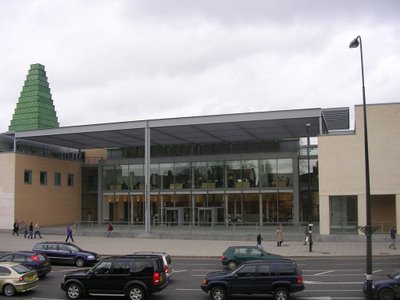
Saïd Business School (SBS)
First big building leaving the train station at Oxford. SBS is the business school of the University of Oxford. After a gift of £20 million from Wafic Saïd in 1996 the former 'University of Oxford School of Management' became the Saïd Business School. (The gift was contested by Oxford students at the opening of the new building in 2001 - after an extra donation of £3 million for constructing the building-. The students claim Saïds fortune comes from questionable armaments deals between UK and Saudi Arabia.)
The MBA programme ranked 20th worldwide and 2nd in the UK in the Financial Times Global MBA Rankings 2006.
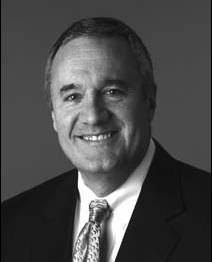
Wafic Riad Saïd
A Syrian businessman(1939) who became a multi-millionaire working for the Saudi Royal Family as a consultant in the fields of infrastructure and armaments projects.
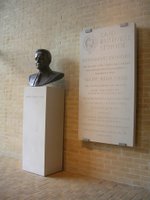
Saïd Business School entrance
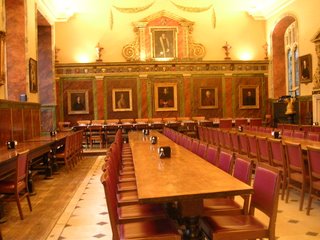
Dining hall, Trinity College
One of the smaller (ca. 300 students) of the 39 colleges at Oxford admitting students for degree courses (1555).
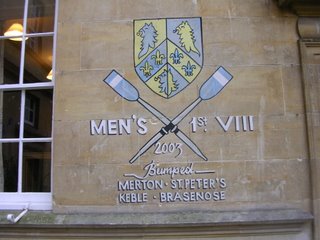
Student house at Trinity College, rowing team.

English breakfast, while contemplating the idea of building a future leadership academy or institute out of OMEC

Christ Church
A unique institute with a dual function. On the one hand it is one of the largest colleges in the University of Oxford. On the other hand it is also the church for the Diocese of Oxford. The Cathedral still follows the old Oxford Time which is five minutes west of Greenwich. (6 p.m. Oxford time is 6.05 p.m. GMT). Every day at '6' the Cathedral Choir will sing in the church.
Tuesday, December 12, 2006
Top Business Schools in Europe - Where To Get Your Top MBA
1. London Business School, UK. Ranked nr 1 in the Financial Times top ten business school listing. MBA tuition fees: 42.500 £. http://www.london.edu
2. Insead, Paris/Fontainbleau, France. Executive MBA tuition fees: 85.000 €. http://www.insead.edu
3. HEC, Paris, France, l’Ecole des Hautes Etudes Commerciales. EMBA tuition fees: 41.200 €. http://www.hec.fr
4. Cass Business School, City University, London, UK. The EMBA was ranked third-best in Europe by the FT. EMBA tuition fees: 31.000 £. http://www.cass.city.ac.uk
5. Otto Beisheim School of Management, Frankfurt, Valladur, Germany. Linked with Northwestern Kellog School of Management, USA. Named after billionaire Otto Beisheim, owner of Media Markt. EMBA tuition fees: 57.000 €. http://www.whu.edu
6. Vlerick Leuven Gent Management School, Leuven/Gent, Belgium. Stats show it is the number one global school for graduates gaining employment within three months. Part-time MBA tuition fee: 19.000 €. http://www.vlerick.be
7. Instituto Empressa, IE, Madrid, Spain. Is considered a 'high pressure' school. EMBA tuition fees: 41.000 €. http://www.ie.edu
8. SDA Bocconi School of Management, Milan, Italy. Milans's Bocconi University is the country's top business college and the School of Management its top graduate business school. Part-time EMBA fees: 28.000 €. http://www.sdabocconi.it/md
Did you study at one of these fine universities ? Do you agree with above ranking ?
Thursday, November 30, 2006
10 remarkable points to remember Friedman by (5/5)
Milton Friedman (31/07/1912 – 16/11/2006)
1. 20th century economics showed 2 major important economical schools: the ‘Keynesian economics’, an economic theory based on the ideas of John Maynard Keynes, and ‘Monetarism’ a theory largely attributed to Milton Friedman.2. Friedman attacked Keynes beliefs in the 1950’s in his book ‘A Theory of the Consumption Function’. But Friedman acknowledged the fact that even he started out as a Keynesian. “We all use the Keynesian language and apparatus; none of us any longer accepts the initial Keynesian conclusions", he says.
3. Keynes says the economy is best served by government and parliament. They have to regulate the economy via taxes and government spending. Friedman and the monetarists on the other hand argue government should not interfere with economy at all. The economy should be left to the people and the companies. Exceptionally central banks can interfere and influence the economy through regulation of the quantity of money. Monetarists speak of ‘laissez-faire economics' (economic theory based on the belief that markets and the private sector could operate well on their own, without state intervention).
4. According to Keynes (1957) individual consumption depends on wages, and therefore it is an unstable parameter. Increase in wages leads to more consumption, dismissals lead to decreased consumption. Friedman does not agree: it is the ‘income-expectation on long term’, the so called ‘permanent income hypothesis’ that influences consumption. It means that consumers will spend not driven by their current income, but by their long term income expectations. Individual consumption is therefore a much more stable parameter.
5. Keynesians argue that the quantity of money should not be considered as a reliable economical instrument because the circulation speed of money is not constant. Friedman however proved that the money velocity as well as money production is constant. This means that the quantity of the money determines price setting and the level of inflation (the supply of money being larger than the demand for money). The inflation is to be regulated by controlling the amount of money poured into the national economy by the National Banks.
6. Nobel Price for Economic Science in 1976 for his work on consumption analysis and monetary theory.
7. Friedman played a remarkable role in the abolition of the draft in the 1970s in the U.S. He stated that his role in eliminating the draft was his proudest accomplishment.
8. Friedman was a Professor of Economics at the University of Chicago from 1946 to 1976. He created an intellectual community that produced a number of Nobel Prize winners, known as the 'Chicago School of Economics'.
9. Friedman co-wrote and co-produced ‘Free to Choose’ with his wife Rose D. Friedman. They also created the 'Milton and Rose D. Friedman Foundation', an organisation determined to introduce and promote schoolvouchers in the American schoolsystem as well as the freedom of choice in education. Their memoirs are published as ‘Milton and Rose D. Friedman, Two Lucky People’ (1998). Milton Friedman claimed that Rose was probably the only person in the world to have ever won an argument from him.
10. Milton Friedman was cremated. He wanted his ashes be scattered over the San Francisco bay.
Sunday, November 26, 2006
"There's no such thing as a free lunch" and other quotes from Friedman (4/5)
2. I'm in favor of legalizing drugs. According to my values system, if people want to kill themselves, they have every right to do so. Most of the harm that comes from drugs is because they are illegal.
3. The most important single central fact about a free market is that no exchange takes place unless both parties benefit. 4. The most important ways in which I think the Internet will affect the big issue is that it will make it more difficult for government to collect taxes.
5. Inflation is caused by too much money chasing after too few goods.
6. On the difference between public vs. private education: "Try talking French with someone who studied it in public school. Then with a Berlitz graduate."
7. There's no such thing as a free lunch.
8. The problem of social organization is how to set up an arrangement under which greed will do the least harm, capitalism is that kind of a system.
9. The only way that has ever been discovered to have a lot of people cooperate together voluntarily is through the free market. And that's why it's so essential to preserving individual freedom.
10. The power to do good is also the power to do harm.
Wednesday, November 22, 2006
6 Quotes from Friedman about Government (3/5)
1. Governments never learn. Only people learn.2. Many people want the government to protect the consumer. A much more urgent problem is to protect the consumer from the government.
3. Only government can take perfectly good paper, cover it with perfectly good ink and make the combination worthless.
4. The black market was a way of getting around government controls. It was a way of enabling the free market to work. It was a way of opening up, enabling people.
5. President Kennedy said, "Ask not what your country can do for you - ask what you can do for your country."... Neither half of that statement expresses a relation between the citizen and his government that is worthy of the ideals of free men in a free society. "What your country can do for you" implies that the government is the patron, the citizen the ward. "What you can do for your country" assumes that the government is the master, the citizen the servant.
6. We have a system that increasingly taxes work and subsidizes nonwork.
Tuesday, November 21, 2006
Friedman on Freedom (2/5)
Monday, November 20, 2006
Milton Friedman dies at 94 (1/5)
You spend your own money on yourself.
You spend your own money on someone else.
You spend someone else’s money on your own.
You spend someone else’s money on someone else.
Also read:
- IMPACTROOM for managers, marketeers and mothers*: Friedman on Freedom (2/5)
- IMPACTROOM for managers, marketeers and mothers*: 6 Quotes from Friedman about Government (3/5)
- IMPACTROOM for managers, marketeers and mothers*: "There's no such thing as a free lunch" and other quotes from Friedman (4/5)
- IMPACTROOM for managers, marketeers and mothers*: 10 remarkable points to remember Friedman by (5/5)
Wednesday, November 15, 2006
Who Becomes Great ? The 10-Year-Rule.
(The ten-year rule represents a very rough estimate, and most researchers regard it as a minimum, not an average. In many fields (music, literature) elite performers need 20 or 30 years' experience before hitting their zenith.)
So greatness isn't handed to anyone, it requires a lot of hard work. Yet that isn't enough, since many people work hard for decades without approaching greatness or even getting significantly better. What's missing ? The best people in any field are those who devote the most hours to what the researchers call 'deliberate practice'. It is activity that's explicitly intended to improve performance, that reaches for objectives just beyond one's level of competence, provides feedback on results, and involves high levels of repetition. For example: Simply hitting a bucket of balls is not deliberate practice, which is why most golfers don't get better. Hitting an eight-iron 300 times with a goal of leaving the ball within 20 feet of the pin 80% of the time, continually observing results and making appropriate adjustments, and doing that for hours every day - that's 'deliberate practice'. Consistency is crucial.
Monday, November 13, 2006
People of the Night (Preparation Economy)

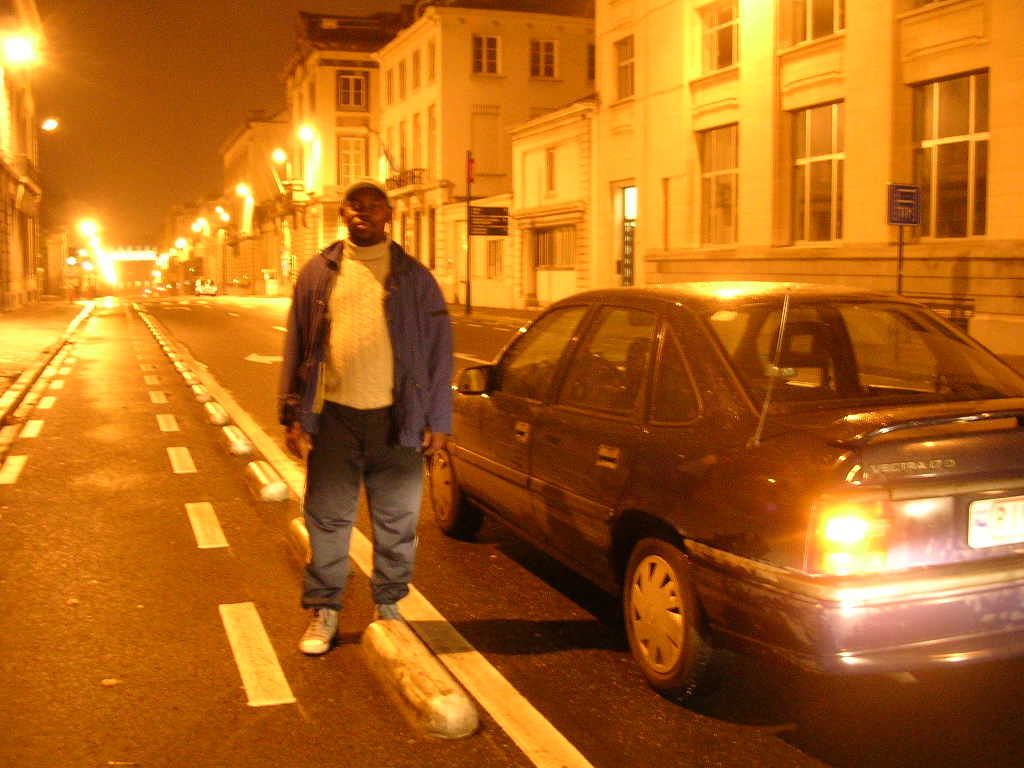
They are the people of the night, the DP's (delivery persons), the people that deliver the most sophisticated newspapers and magazines of the world to your door in the middle of the night. So that you, the reader, can read or at least go through the newspaper or mag before you go to work. The people of the night are at the bottom of the food chain in distribution country. There couldn't be a
bigger difference in way of living between the DP's and the readers they serve.(DP Lino in Brussels, capital of Europe, serving the
Always at round in the deserted capitals of the world, living of cheap coffee (not Red Bull, too expensive) and junkfood from the night shops, in the worst imaginable sorts of
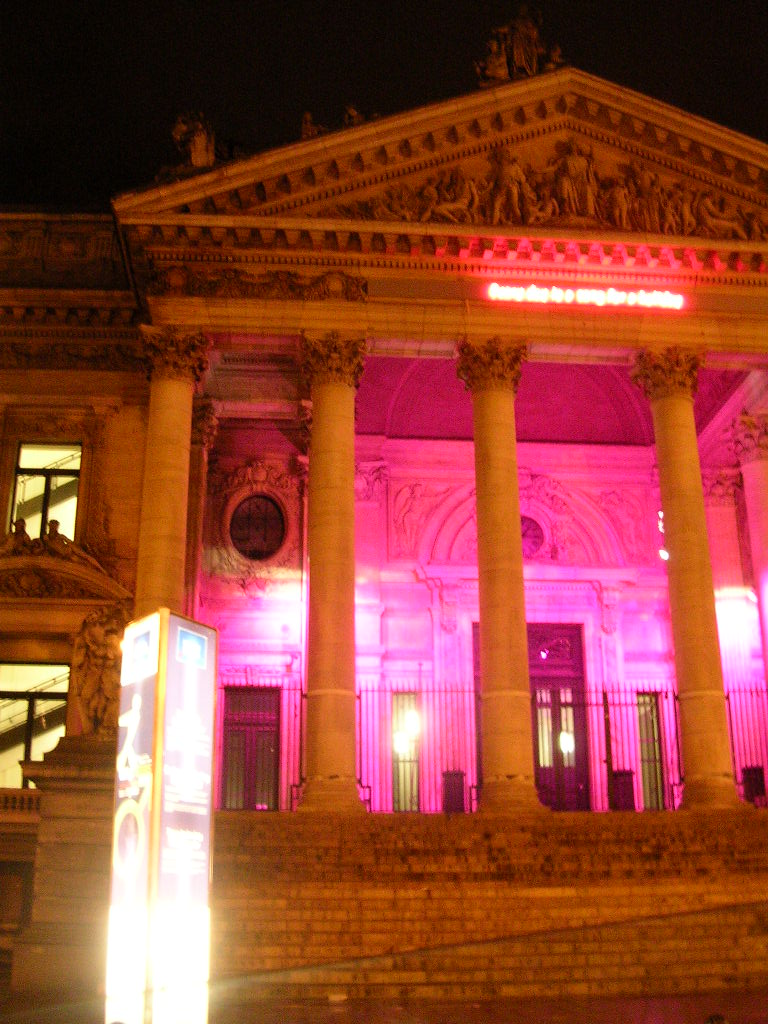
weather, to be able to go at home around 7 AM after having digested the morning traffic jams, often to go(Delivery of the Wall Street Journal, the Financial Times, The Times, to companies and institutions around the Brussels stock exchange)
to a second job in the early afternoon, before returning to the nightly newspaperworld again
(Night manager Luc in a Brussels warehouse preparing
that same evening. I have a deep respect for our People of the Night, without them my job would be meaningless, our customers, both readers and advertisers, wouldn't be served. They run what I call a 'preparation economy' during the night. Every action they undertake serves a higher goal during the day. They ship, handle, pack and label products, the essence being 'creation of movement' so our daytime economy wouldn't come to a standstill because lack of products or information.
Thursday, November 02, 2006
week 44 - a few days in the Ardens - Pareto/Zipf distribution
The best known manifestation of Pareto/Zipf distributions is the 80/20 Rule, which is often used to explain that 20 % of products count for 80 percent of revenues, or 20 percent of our time accounts for 80 percent of our productivity, or any number of other comparisons that all share this characterisitic of a minority having disproportionate impact.
Wednesday, October 25, 2006
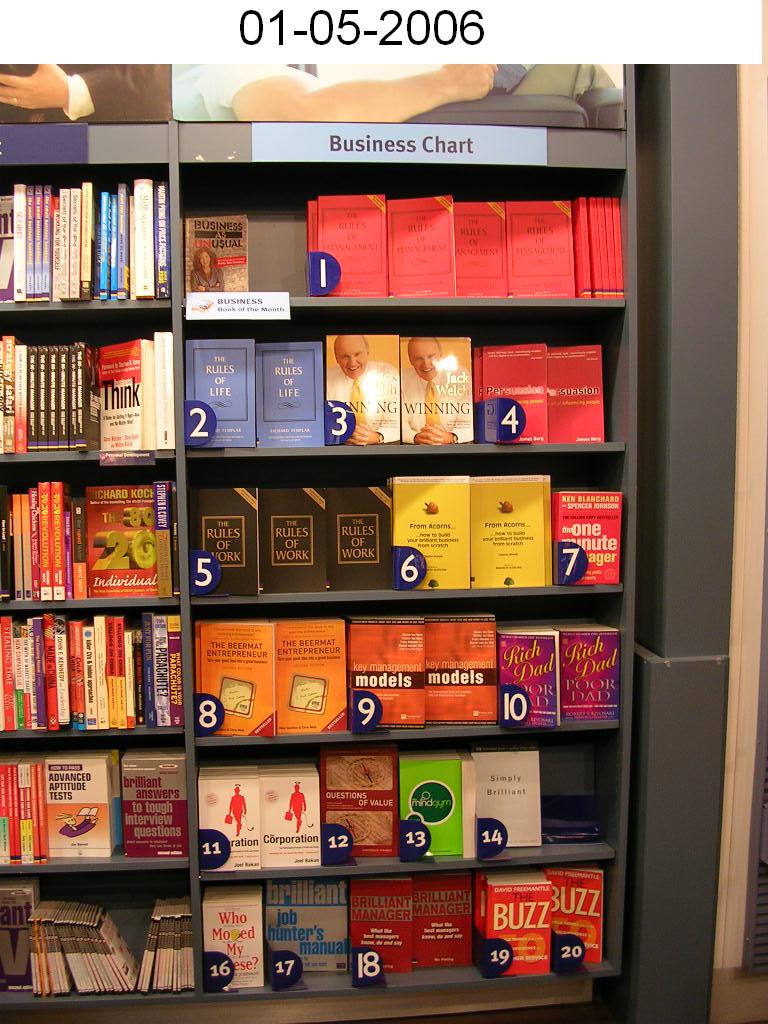
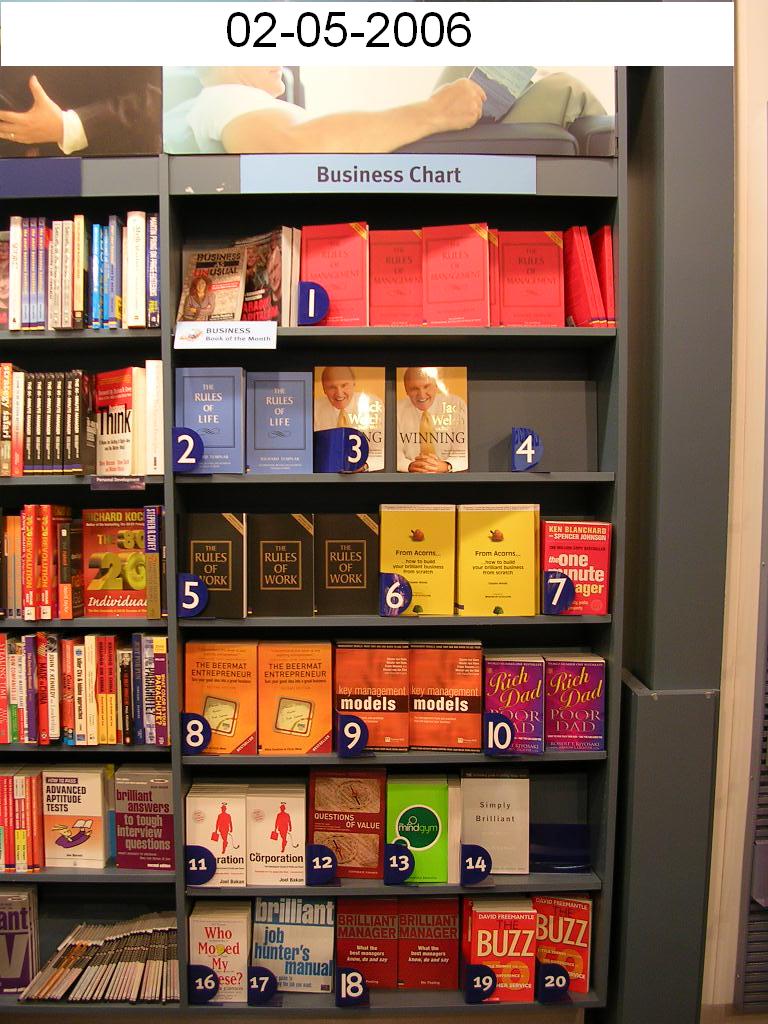
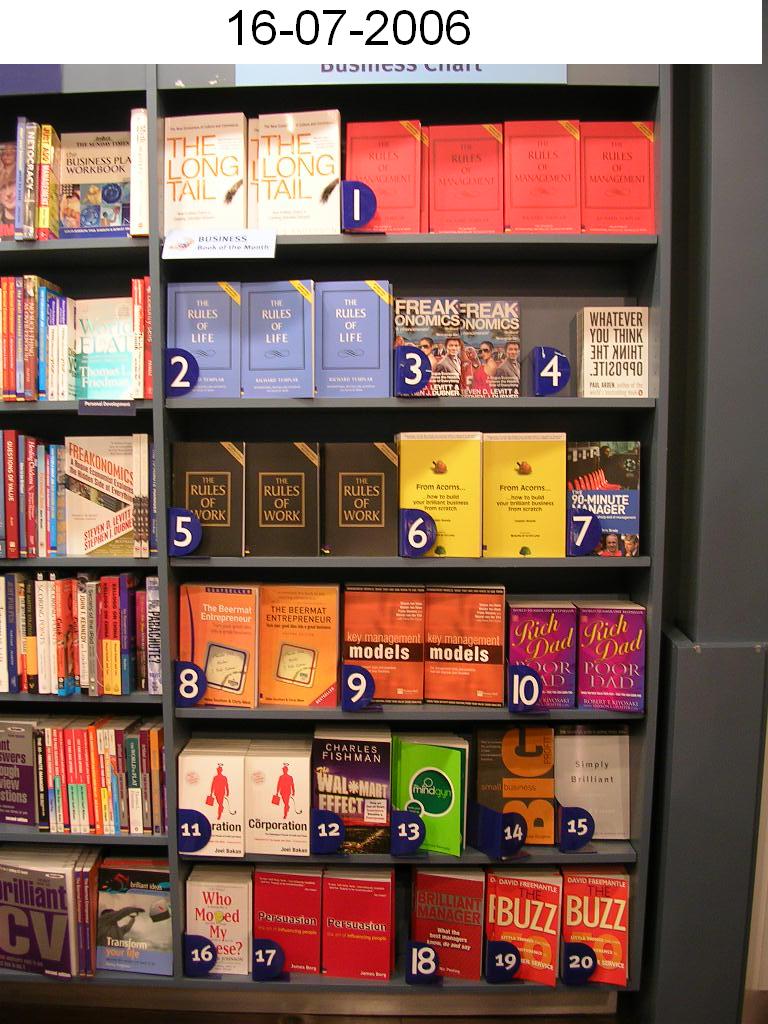
London City Airport Bookstore - Business Chart
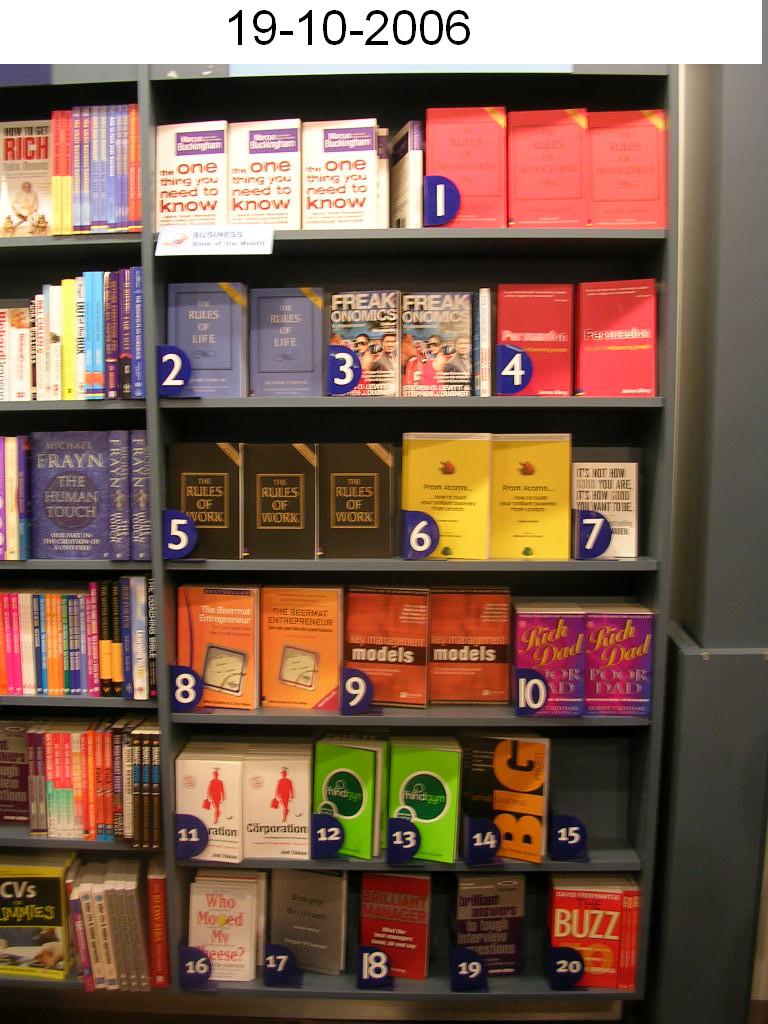
I also like to wait a bit between the detectives and the historic novels, from where you have an excellent but somewhat hidden view on the Business Charts to check out who is buying the management books (it is also the perfect place from where to take a quick picture with a digital camera -amateur results see below- without being noticed or reprimanded by smiling yet unforgiving young African store clerks). The results speak for themselves. Buyers of business books are male, male, male (I have never ever seen a woman buy a management book). The younger buyer is around his thirties and wears a smart costume. He is to become the next CEO of the company he works for. The older buyer is around his late forties, begin fifties and wears a shabby costume. He always dreamt of the CEO position in one of the companies he worked for. Recently he became self-employed because he was a victim of a rationalization round in his last company.


Friday, October 20, 2006
Following New Trader Magazine to its UK Market
I followed the first issue of Trader magazine produced and co-published by Dow Jones, from the Belgian printplant to the UK market. More than 50.000 traders working in the financial district of London will receive their personal copy this week
.It is by all means a fantastic magazine, brilliantly targeted to high potentials with unearthly high incomes and spending habits.


Distribution in the heart of London to the worlds biggest financial conglomerates, grouped around Bishopsgate or Canary Wharf is an art on its own.
Magazines are transferred from dark underground loading docks protected by grim looking guards, via shabby elevators to marble led corridors and design lit reception area's, operated by stunning receptionists drawn from tv commercials.
I had the privilege of accompaning Jimmy and Diane, a couple that lives from distributing newspapers and magazines to this schizophrenic world day by day, never in bed before 4 AM, to be at work again before noon time. (They have 1 client they are really proud of, Downing Street 10, the house of the prime minister, who wants all major UK newspapers delivered to his door within 15 minutes after printing)


London, Canary Wharf, after work drink
Tuesday, October 17, 2006
Albrecht on outsourcing war (7)
"Business experts are fond of advising companies to "outsource" - i.e. have somebody else do - everything but their "core competencies." This has led to a global shake-out as various business functions get outsourced to countries (and companies in those countries) who are able to do it cheaper (and sometimes better).This leads to an intriguing proposition: all countries could outsource their warmaking efforts to the United States. After all, the US is clearly the leading military force in the world, with the latest technology and the most highly trained, expert fighters. No other country makes war as well as the US does. If all countries outsourced their warmaking to the US, they could be sure of getting the best operations for their money.
Where would this lead? For one thing, the country willing to put up the most money would always win, because both sides would be buying military operations of identical quality.The drawback, one might say, would be that Americans would be fighting against each other. But, if the best-funded side would always win, then Americans could simply scale down the battles to make sure the right sponsor won, but with minimum casualties - and higher profits. In the end, maybe the wars could be fought with computers, and the losing side would have to pay money to the winning side. Would this work?"
Monday, October 16, 2006
Albrecht: 3 things leading to organizational intelligence (6)
Karl Albrecht: "The best way is for the senior leaders of the organization to start thinking and talking about their enterprise as a potentially intelligent operation, and to undertake a never-ending assessment of its possibilities for advancement. There should be an ongoing conversation around the simple question: "How can we operate more intelligently?"
The second step is to start giving people the authority to think. When even the lowliest worker believes that his or her ideas, experiences, insights, and suggestions will be listened to and appreciated, we begin to liberate more of the tremendous brainpower that we've already hired - and that we're already paying for every payday.
The third step is a systematic, relentless, and never-ending attack on the causes of collective stupidity: organizational structures that don't make sense; "silos" that have grown up between departments or factions; policies, rules, and procedures that thwart the value-creation process; incompetent, ineffective, or failing managers; turf wars between managers and departments; union-management conflict; caste systems that have grown up in the organization; top-management behaviors that confuse, divide, or demotivate people; unfair or unjust
treatment of employees that destroys morale and the sense of shared fate; and, sometimes, even the lack of a clearly defined vision and mission.
The most intelligent organizations operate on the principle that 'good is never good enough'."
Friday, October 13, 2006
Impactroom Readership Explodes
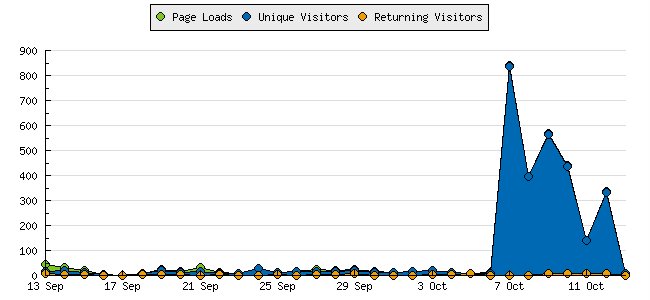
I have no idea how nor why it happened, but suddenly the Impactroom blog started receiving serious numbers of visitors. From an average of 30 visitors a day readership exploded to nearly 900 visitors last Saturday. The graph shows a decline after the initial peak, but still, some 3000 visitors in 1 week, that's quite spectacular for a blog this size. All the visitors are coming from the US, that makes it more mysterious. On top of that the visitors come from all over the US, the readership is not concentrated at all. If anyone has an idea what could have happened, don't hesitate to contact me. Thank you all for the tremendous support and interest.
Thursday, October 12, 2006
Albrecht's Law: Examples of Successful Organizational Intelligence and Collective Stupidity (5)
An example of an organization that suffered from 'collective stupidity':
Karl Albrecht: "One of the most legendary episodes of collective stupidity was with Ford Motor Company in Detroit. In the early 1980s, they launched a new advertising program with the slogan "No unhappy owners." The TV ads promised that every Ford owner would have a car he or she was happy with, and if there was anything wrong, the company would make it right. The only problem was that they neglected to tell several thousand dealers about the ads. The dealers were swamped with unhappy owners, who became more unhappy when the dealers couldn't handle the volume of traffic.
This is the quintessential case of what I call "ballistic podiatry," otherwise known as shooting one's self in the foot."
An example of an organization that successfully utilized Organizational Intelligence:
Karl Albrecht: "On the opposite side, one of the legendary examples of collective intelligence, which has been going on for many years, is the remarkable orchestration of the daily experience of magic in the Disney theme parks. From the recruitment, indoctrination, training, placement, and supervision of the employees, all the way to the design and maintenance of the facilities, the delivery of customer value expresses the Disney business model, which is "fun and fantasy in a theatrical setting." Disney designers and managers are some of the world's best experts at eliminating the contradictions to the core proposition of value."
Wednesday, October 11, 2006
Albrecht on Imagination (4)
Karl Albrecht: In all of the developed economies, organisations are shifting from "thing-work" to "think-work." This applies to government and the non-profit sector as well as the corporate sector. In the knowledge economy, fewer and fewer people make their living by making things, and more of them make their living by working with data, information, and knowledge. This means that practical thinking skills - including imagination, but certainly not limited to that - will be ever more in demand.
HR experts predict an increasingly severe "smart gap," meaning that we'll have a tougher time finding employees who can think beyond their noses. Inasmuch as the public education systems are failing miserably to provide us with the smart people we need, we will find it necessary to grow our own smart people. I believe more and more organisations will take up the role of educator of last resort, and invest more heavily in the mental competence of their workers.
At a time when companies are spending tens of millions of dollars on information technology - the machine software - they've so far not seen fit to spend a few tens of thousands of dollars on improving the mental skills of their employees - the human software. As we begin to realize how much of the IT investment is being wasted or misdirected, I believe we'll be spending less on the machine software and more on the human software.
Tuesday, October 10, 2006
Karl Albrecht, the WASM and the 7 components of Organizational Intelligence (3)
According to the training manual of a restaurant chain that espoused the WASM, the manager should first explain to the employee what a WASM is and why it is important to be able to give one. Then the manager should say, "Now I'm going to demonstrate a WASM," after which he would WASM the employee. "Now it's your turn. Please demonstrate a WASM for me" after which the employee should WASM the manager.
Now that your curiosity is piqued, a "WASM" is "a warm and sincere smile."
As long as we give employees the impression that thinking of any sort is not allowed, Organizational Intelligence (OI) is not a possibility. Albrecht arguments that management needs to think of and treat employees as the self-motivated adults they are. And that's what the 7 components of OI spell out. Strategic vision is the sense of purpose and direction of the organization. Performance pressure includes the basics to get there: performance goals, clear roles and responsibilities, and feedback. Alignment and congruence are structural in nature and include structures that are appropriate to the mission and priorities, yet empowering and enabling employees to get their jobs done. Shared fate is the "we're all in this together" feeling--that everyone is treated as and feels as a valued member of the organization. Knowledge deployment is the flow of information into and around the organization. It includes cultural and structural elements to encourage and allow this to happen. Appetite for change is the culture of continuous improvement. With these pieces in place, then the valued and valuable employees who have a clear understanding of the direction, who understand their role in achieving that goal and feel that they have the freedom to get their job done, who can get the information they need, and even change the organization if needed, can provide the heart. Heart is commitment to the organization accompanied by the motivation to move the entire company ahead. It goes beyond just doing one's own job (or even doing it well).
Monday, October 09, 2006
Albrecht's Law of Collective Stupidity (2)
- strategic vision
- appetite for change
- alignment and congruence
- performance pressure
- knowledge deployment
- heart
- shared fate
Many managers have an unconscious belief about workers or employees as being separate from, and maybe not quite as good as, "the organization." To this day, many of our OI practices and assumptions, and many management practices, may still be based on the assumption that employees are basically interchangeable parts of a production machine.
Albrecht thinks this belief impacts OI. He suggests that this belief can be traced back to Taylor, the Father of Scientific Management (Frederick Winslow Taylor 1856 - 1915) who concluded two things from his studies. First, that work procedures were inefficiently designed and second, that the fundamental motivation of hired workers was to do the least amount of work as possible. Further, Taylor is quoted as saying, "Most executives want workers who are house-broken. They talk a good game about wanting highly motivated employees who can add value, but when it comes down to particulars they really value obedience. Many executives are threatened by smart people below them."
Albrecht argues that these believes are somehow still to be found in companies today. He gives many examples of this happening in businesses that he is consulting with currently. It occurs on many different levels. It can be just the way management refers to employees as "a resource" (which according to Albrecht is patronizing and trite). At its worst, Albrecht calls it the "rabble hypothesis" or the view of employees as the "great unwashed: unintelligent, unmotivated, socially naive, and incapable of original thought."
Friday, October 06, 2006
Albrecht's Law: “Intelligent people, when assembled into an organization, will tend toward collective stupidity.” (1)
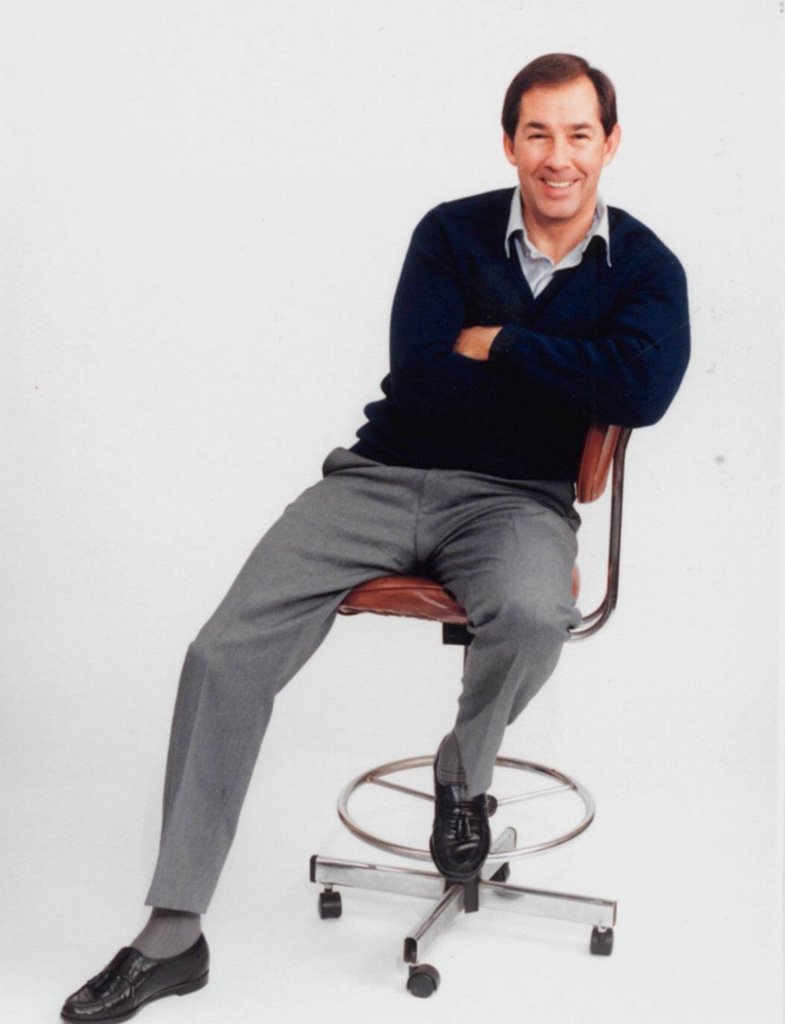
In the early morning hours of September 30, 1999, NASA’s Mars climate orbiter spacecraft, a $125 million marvel of engineering, designed to orbit Mars, suddenly disappeared from the screens of mission control and, seconds later, its signal vanished for ever. An investigation of this incident revealed that the NASA engineers who wrote the navigation software for the orbiter had been working in separate groups and had apparently not approached the mission as a whole. In fact, one group had been programming its calculations using metric units – kilometers and kilograms – while the other had been relying on American style English units – miles and pounds. That led to the critical flaw in the orbiter’s navigation. It inevitably burned to crisps due to friction with the atmosphere of Mars.In his book “The Power of Minds at Work”, Karl Albrecht (picture) cites this case as an example for what is been known now as Albrecht’s law: “Intelligent people, when assembled into an organization, will tend toward collective stupidity.”
Arguing that in organizations, the sum of all individual minds only rarely equals the level of organizational intelligence, he identifies several factors that may contribute to this dysfunction. Based on more than 25 years’ experience as a consultant, Albrecht contends that organizational “entropy” (that is, the energy of a system that remains unavailable for conversion to work), ineffective decision-making processes, and cultural clashes arise in every organization. With employees working in separate departments, each department protecting its turf and often not knowing what the others are doing, “collective brain power gets wasted,” Albrecht says, thus compromising the mission of the enterprise. Collaboration and knowledge management, the two major buzzwords of today’s enterprise, may work on academic paper but are far from being effectively applied in practice.
Tuesday, October 03, 2006
Concepticide
Friday, September 29, 2006
He who builds a museum must truly be a leader.
My old professor in Sports History, Prof.Dr.R.Renson always dreamt of a professional Sports Museum. After years of hardship he finally succeeded in creating probably one of the most interesting museums in the Benelux. He who builds a museum from scratch must truly be a leader, and most certainly a people manager.Truth is, it was not the collection nor one outstanding object that took me by surprise. It were...the toilets.
(Don't hesitate to visit the museum, Sportimonium, Hofstade, Belgium and especially the unique Flemish Folk Games Garden)(www.sportimonium.be)
Thursday, September 28, 2006
"Flanders fits you"
Blauw 2945 100/45/0/14% 0/87/166 ID649F 5017
Paars 5135 47/64/28/0% 140/92/122 956E8E 4001
Oranje 153 0/46/100/18% 184/105/5 D18316 2000
Groen 356 95/0/100/27% 0/115/54 00853E 6010
Rood 704 0/90/72/29% 158/38/41 B42C33 3002
Geel 123 0/24/94/0% 252/201/23 FEC423 1004
Zwart Black 0/0/0/100% 0/0/0 000000 9005
What is this code?
This code is the new Flanders, the region in Belgium where I come from. The Government of Flanders decided to create a proper logo. Flemings can apply for the u
se of the logo in their own organisation, company or service. The figures above indicate the colorconfiguration of the logo for external printers. One sentence struck me when I read the press-kit. "The new logo is thus not the logo of the Flemish Government, but of Flanders, which is precisely why it can be used by any Flemish organisation or service for its own communication abroad.".Baseline to go with the logo is in 4 languages: "Flanders fits you", "La Flandre vous va bien", "Flanderen passt zu dir", "Vlaanderen past je perfect".
Graphically speaking, the new logo is used as sub-logo, which means that it is subordinate to the logo of the relevant organisation or service itself. It is a qualitative label of origin, an “appellation d’origine”, which says: “This is from Flanders.”
Wednesday, September 27, 2006
End of 10 management lessons based on stories and jokes.
Monday, September 25, 2006
Management Lesson 10/10 (India)
The man returned to camp and spent several hours perfecting his aim for short distances and quick firing. On the following day, he again stalked the tiger. Finally, he spotted the beast at some distance. The tiger was practicing his short leaps.
Management lesson: Don' t think too soon you are ahead of your enemy/competitor.
Friday, September 22, 2006
Management Lesson 9/10
Mr. Wrigley replied, "How fast do you think this airplane is flying?" The man answered, "Oh, I guess about 600 miles per hour." Mr. Wrigley responded. "I think that's fast enough, don't you?" The man agreed that indeed, it was fast enough. "Well then," asked Mr. Wrigley, "why doesn't the pilot turn off the engines and save all that expensive jet fuel?"
Thursday, September 21, 2006
Management Lesson 8/10 - "Where to Place Them"
If they have taken the table apart, put them in Engineering.
If they are counting the butts in the ashtray, assign them to Finance.
If they are waving their arms and talking out loud, send them to Consulting.
If they are talking to the chairs, Personnel is a good spot for them.
If they are wearing green sunglasses and need a haircut, Computer Information Systems is their niche.
If the room has a sweaty odour, perhaps they're destined for the Help Desk.
If they mention what a good price we got for the table and chairs, put them into Purchasing.
If they mention that hardwood furniture DOES NOT come from rainforests, Public Relations would suit them well.
If they are sleeping, they are Management material.
If they are writing up the experience, send them to the Technical Documents team.
If they don't even look up when you enter the room, assign them to Security.
If they try to tell you it's not as bad as it looks, send them to Marketing.
Wednesday, September 20, 2006
Management Lesson 7/10
"Excuse me," he shouted. "Can you help me? I promised my friend I would meet him a half hour ago, but I don't know where I am."
The man below responded: "Yes. You are in a hot air balloon, hovering approximately 30 feet above this field. You are between 40 and 42 degrees North Latitude, and between 58 and 60 degrees West Longitude."
"You must be an engineer," responded the balloonist.
"I am," the man replied. "How did you know?"
"Well," said the balloonist, "everything you have told me is technically correct, but I have no idea what to make of your information, and the fact is I am still lost."
Whereupon the man on the ground responded, "You must be a manager."
"That I am" replied the balloonist, "but how did you know?"
"Well," said the man, "you don't know where you are, or where you're going. You have made a promise which you have no idea how to keep, and you expect me to solve your problem. The fact is you are in the exact same position you were before we met, but now it is somehow my fault."
Tuesday, September 19, 2006
Friday, September 15, 2006
Management Lesson 5/10
The Genie says, "I usually only grant three wishes, so I'll give each of you just one."
"Me first! Me first!" says the admin clerk "I want to be in the Bahamas, driving a speedboat, without a care in the world." Poof! She's gone.
In astonishment, "Me next! Me next!" says the sales rep. "I want to be in Hawaii, relaxing on the beach with my personal masseuse, an endless supply of pina coladas and the love of my life." Poof! He's gone.
"OK, you're up," the Genie says to the manager.
The manager says, "I want those two back in the office after lunch."
Management Lesson: Always let your boss have the first say.
Thursday, September 14, 2006
Management Lesson 4/10 (India)
Management Lesson:
1) Not everyone who drops s**t on you is your enemy.
2) Not everyone who gets you out of s**t is your friend.
3) When you're in deep s**t, keep your mouth shut!
Wednesday, September 13, 2006
Management Lesson 3/10
Management Lesson: You don't need brains to be a Boss - any a**hole will do.
Tuesday, September 12, 2006
Management Lesson 2/10 (India)
Management Lesson: Bulls**t might get you to the top, but it won't keep you there.
Monday, September 11, 2006
Management Lesson 1/10 (India)
Management Lesson: To be sitting and doing nothing, you must be sitting very high up.
Thursday, September 07, 2006
10 Rules To Manage Knowledge Workers
1. Hire by committee
2. Cater to their every need
3. Pack them in
4. Make coordination easy
5. Eat your own dog food
6. Encourage creativity
7. Strive to reach consensus
8. Don’t be evil
9. Data drive decisions
10. Communicate effectively
As they mention in the article non of these items are new, nor are they really that revolutionary. The success of the items seems to be directly related to the way they are implemented.
Wednesday, September 06, 2006
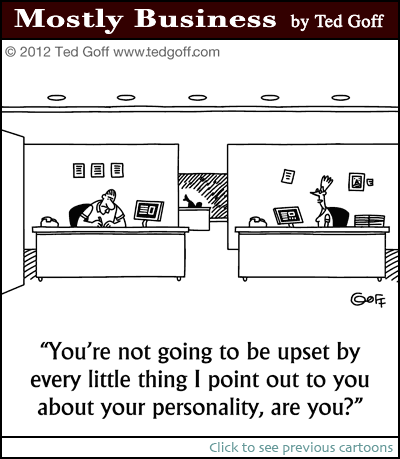
Mostly Business
Monday, September 04, 2006
Friday, September 01, 2006
Colin Powell: Leadership Lesson 19/20: "Command is lonely"
Harry Truman was right. Whether you're a CEO or the temporary head of a project team, the buck stops here. You can encourage participative management and bottom-up employee involvement, but ultimately the essence of leadership is the willingness to make the tough, unambiguous choices that will have an impact on the fate of the organization. I've seen too many non-leaders flinch from this responsibility. Even as you create an informal, open, collaborative corporate culture, prepare to be lonely.